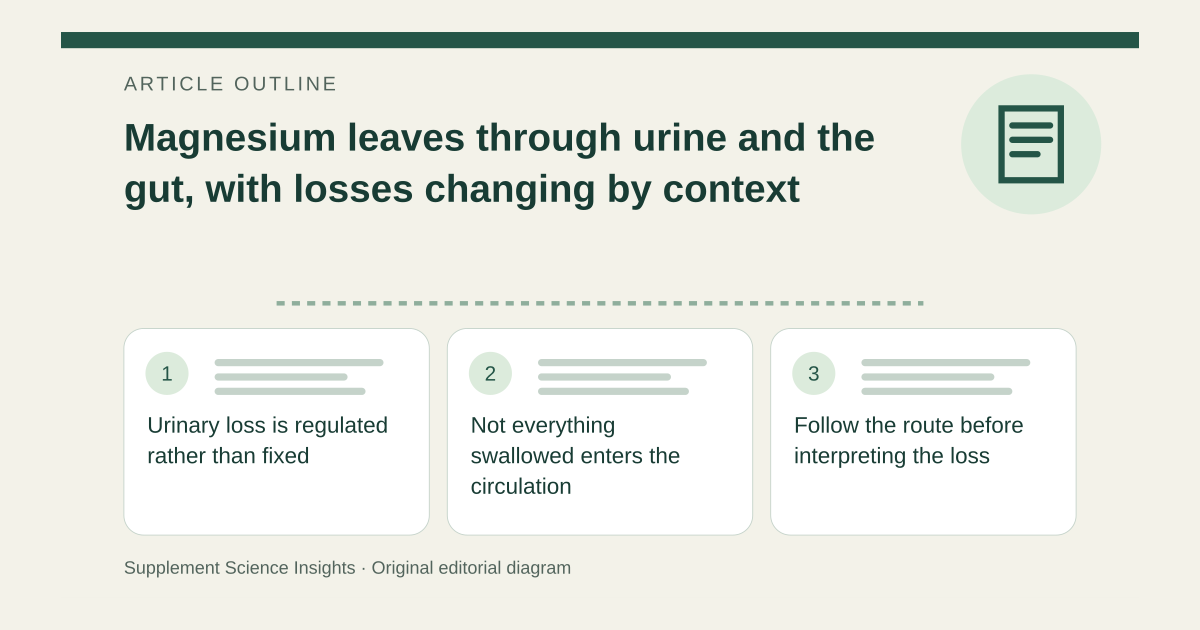
Urinary loss is regulated rather than fixed
NIH ODS describes the kidneys as major regulators of magnesium balance. They reduce urinary excretion when magnesium status is low, helping conserve the mineral. [1]
That response is one reason a usual daily excretion estimate cannot be treated as a fixed amount lost by every person. Kidney function, magnesium status and some medicines can change urinary handling. [1]
Not everything swallowed enters the circulation
Part of ingested magnesium remains unabsorbed. Chronic diarrhea and malabsorption can also contribute to depletion, so gastrointestinal loss is not interchangeable with kidney clearance. [1]
A bowel movement after a magnesium laxative therefore cannot show that all absorbed magnesium has been eliminated. Likewise, the time since a dose does not establish a safe next dose when kidney function is impaired or intake has been excessive. [1]
Follow the route before interpreting the loss
Imagine a dose is only partly absorbed and the remainder leaves in stool. That stool loss does not tell you how much of the absorbed fraction is still retained in tissues or circulating.
| Detail | Interpretation |
|---|---|
| Urine | Regulated renal loss |
| Stool | Includes unabsorbed intake |
| Time since dose | Not a body-content measurement |
Sources for this article
- Magnesium - Health Professional Fact Sheet
Source consulted: 2026-09-19. This is a reference resource, not a claim that we conducted the studies or tested a product.