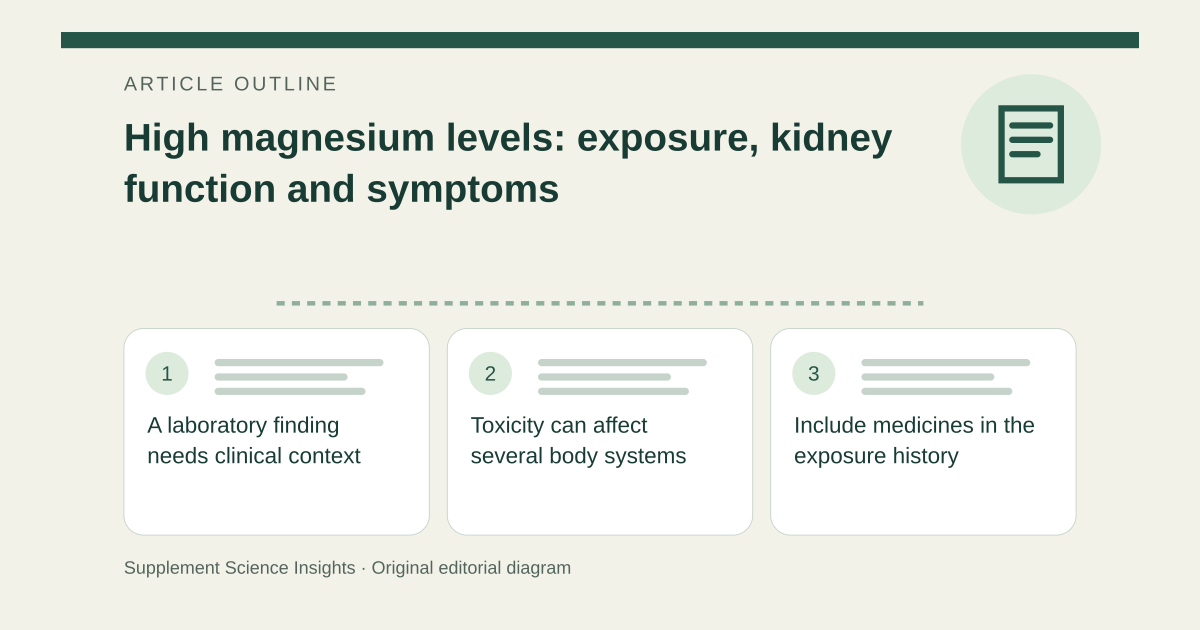
A laboratory finding needs clinical context
The kidneys help regulate magnesium by adjusting how much is lost in urine. When kidney function is impaired, the ability to eliminate excess magnesium falls, increasing toxicity risk. Supplements, laxatives and antacids can all contribute magnesium exposure. [1]
A high result should be interpreted using the laboratory’s reference range and the clinical situation. A symptom checklist or a calculation from a food label cannot establish the blood concentration. [1]
Toxicity can affect several body systems
ODS describes magnesium toxicity as potentially causing low blood pressure, nausea, vomiting, facial flushing, urine retention, lethargy and muscle weakness. More severe toxicity can involve difficulty breathing, an irregular heartbeat and cardiac arrest. [1]
These symptoms are not unique to magnesium excess. Severe weakness, breathing difficulty or a suspected rhythm problem requires urgent medical assessment rather than a home experiment to lower a mineral level. [1]
Include medicines in the exposure history
Imagine someone with reduced kidney function reports taking no magnesium supplement but uses a magnesium-containing laxative. The medicine is still relevant magnesium exposure. Bringing the package helps the clinician identify the ingredient and amount used.
This is why asking only about vitamins can miss an important part of the history. The clinician also needs the timing, actual servings and recent kidney results.
| Observation | Interpretation |
|---|---|
| No vitamin supplement | Does not exclude medicine exposure |
| Magnesium laxative | Record ingredient and actual use |
| Reduced kidney function | Makes clearance especially relevant |
Do not confuse intake limits with a treatment threshold
The adult upper intake limit of 350 mg per day applies to magnesium from supplements and medicines, not magnesium naturally present in food. It is not a blood-level threshold, and kidney impairment can change the safety of a given exposure. [1]
Do not try to treat suspected toxicity by forcing fluids, adding another supplement or changing prescribed medicines without advice. The appropriate response depends on the level, symptoms, kidney function and cause; this page does not provide a home treatment protocol. [1]
Sources for this article
- NIH ODS — Magnesium: Health Professional Fact Sheet
Source consulted: 2026-09-17. This is a reference resource, not a claim that we conducted the studies or tested a product.