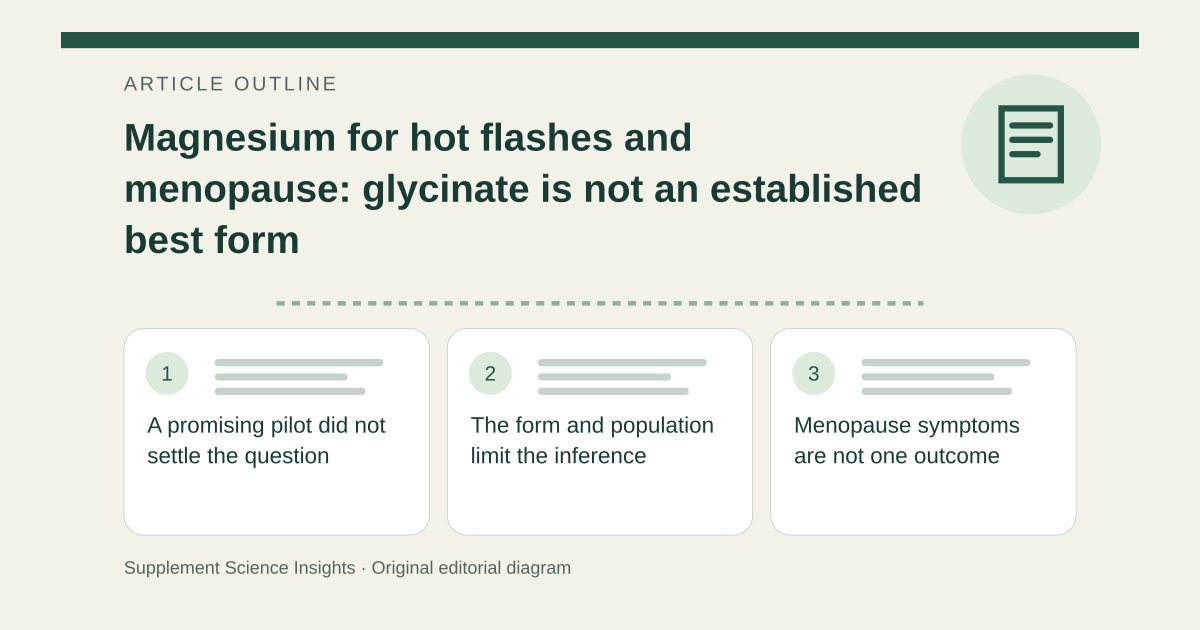
A promising pilot did not settle the question
NCI summarizes an initial magnesium oxide pilot followed by a double-blind placebo-controlled trial in postmenopausal women with a history of breast cancer. The later trial found no benefit for hot flashes. A pilot signal therefore should not be presented as established treatment effectiveness. [1]
The form and population limit the inference
That trial concerns magnesium oxide in a specific population. It does not prove every form can never help anyone, but it also provides no basis to declare glycinate superior. A claim of a best form would need relevant comparative symptom outcomes, not simply a different absorption story. [1][2]
Menopause symptoms are not one outcome
Hot flashes, sleep disruption, mood changes and vaginal or urinary symptoms can require different approaches. A magnesium study measuring sleep or anxiety does not establish relief of vasomotor symptoms or replacement of declining ovarian hormones. [3][4]
Choose treatment around symptoms and medical history
NHS describes hormone therapy, nonhormonal options and menopause-specific cognitive behavioural therapy in appropriate circumstances. A history of breast cancer or other conditions changes the treatment discussion. Magnesium should not be used to bypass that individualized assessment. [3]
A nutritional need remains a separate issue
Correcting an identified magnesium problem can be appropriate, but increasing a dose until hot flashes stop is not a supported regimen. Imagine sleep improves after glycinate while hot flashes persist: that observation does not establish an effective hot-flash treatment or justify escalation, particularly with kidney impairment. [2][1]
| Claim | Evidence needed |
|---|---|
| Fewer hot flashes | Vasomotor symptom outcomes |
| Better sleep | Does not establish hot-flash benefit |
| Glycinate is best | Relevant comparative trials |
| More magnesium will help | Not an established dose strategy |
Sources for this article
- Hot Flashes and Night Sweats (PDQ®) - NCI
Source consulted: 2026-09-21. This is a reference resource, not a claim that we conducted the studies or tested a product. - Magnesium - Health Professional Fact Sheet
Source consulted: 2026-09-21. This is a reference resource, not a claim that we conducted the studies or tested a product. - Treatment for menopause and perimenopause - NHS
Source consulted: 2026-09-21. This is a reference resource, not a claim that we conducted the studies or tested a product. - Examining the Effects of Supplemental Magnesium on Self-Reported Anxiety and Sleep Quality: A Systematic Review - PMC
Source consulted: 2026-09-21. This is a reference resource, not a claim that we conducted the studies or tested a product.