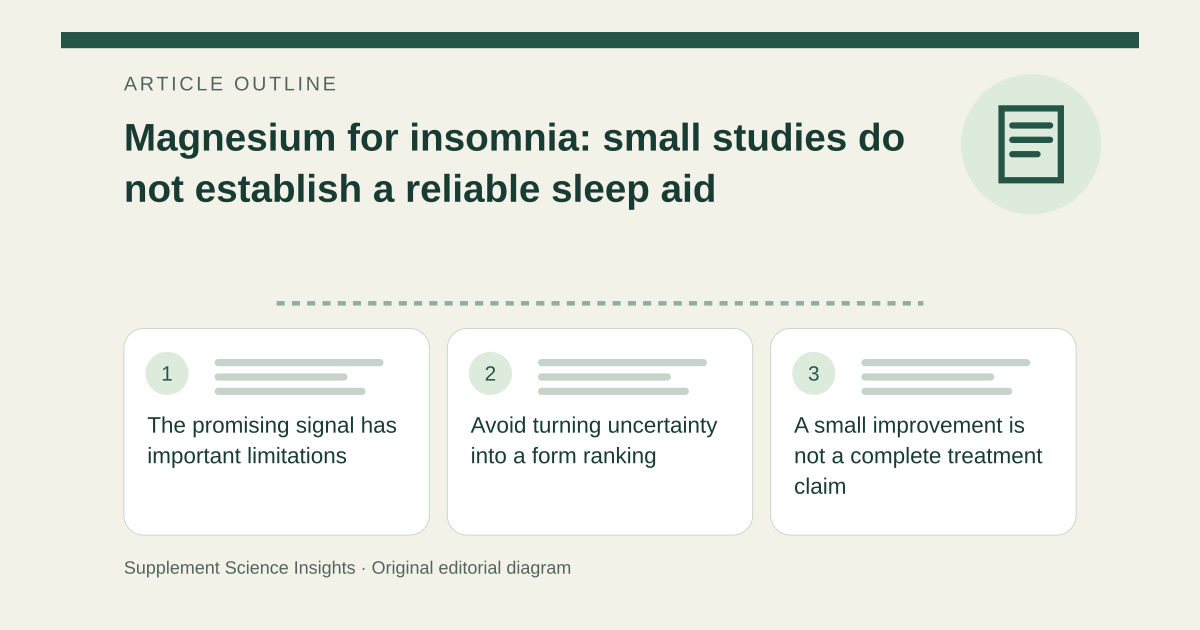
The promising signal has important limitations
NCCIH describes a 2021 review of three studies involving 151 participants that suggested a possible reduction in time to fall asleep among older adults with insomnia. The studies were low quality and inadequate for confident treatment decisions. [1]
A broader 2022 review had conflicting findings for sleep quality and sleep disorders. Those results do not support presenting magnesium as a reliably effective treatment for everyone. [1]
Avoid turning uncertainty into a form ranking
The summary does not establish a best magnesium salt or a precise interval before bed. A product’s calming language is not a substitute for evidence about sleep outcomes. [1]
NCCIH also notes gastrointestinal effects from high supplemental intake and serious toxicity at extreme exposure. Persistent insomnia deserves assessment rather than repeated dose escalation when a supplement does not help. [1]
A small improvement is not a complete treatment claim
Imagine an advertisement cites faster sleep onset in a small trial. That result does not establish longer sleep, better daytime function, or superiority of a different formulation sold under the same mineral name.
| Detail | Interpretation |
|---|---|
| Sleep onset | One outcome |
| Low-quality trials | Limited confidence |
| Best form or timing | Not established by this summary |
Sources for this article
- Sleep Disorders and Complementary Health Approaches: Usefulness and Safety | NCCIH
Source consulted: 2026-09-17. This is a reference resource, not a claim that we conducted the studies or tested a product.