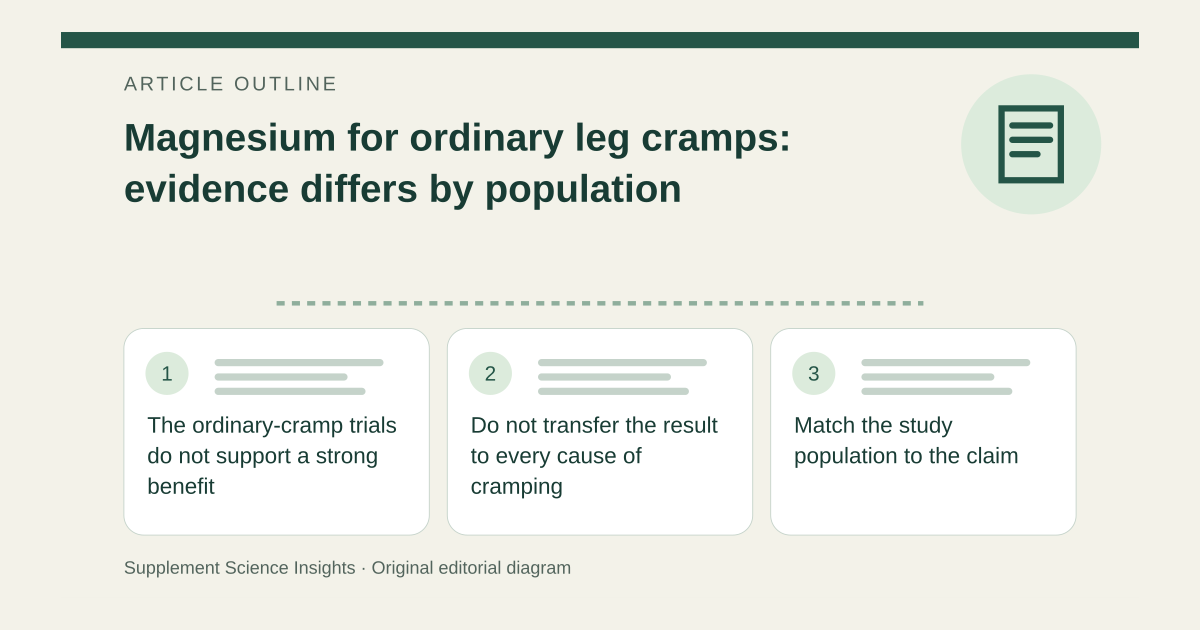
The ordinary-cramp trials do not support a strong benefit
The review’s combined older-adult findings suggested, with moderate certainty, that magnesium was unlikely to reduce cramp frequency or severity. The evidence search was current through September 2019, which should remain visible when interpreting the review. [1]
The conclusion does not establish that one retail salt or a topical magnesium product works better. A form-specific claim requires evidence for that preparation. [1]
Do not transfer the result to every cause of cramping
Pregnancy studies had important limitations and inconsistent results. Evidence for cramps during exercise or associated with particular diseases was also insufficient for a confident general conclusion. [1]
A diagnosed electrolyte deficiency is a separate treatment question. Recurrent cramps should not automatically be labeled magnesium deficiency, and a supplement can itself cause gastrointestinal adverse effects. [1]
Match the study population to the claim
Imagine a product cites pregnancy research to promise relief for all older adults with night cramps. That does not address the more directly relevant older-adult evidence or justify a universal recommendation.
| Detail | Interpretation |
|---|---|
| Older adults with ordinary cramps | Meaningful benefit unlikely in this review |
| Pregnancy | Evidence uncertain |
| Documented deficiency | Different clinical question |
Which magnesium preparations were studied for cramps?
The 2020 Cochrane review included several distinct preparations rather than one standard cramp formula. Examples in idiopathic-cramp studies included citrate supplying 200 mg elemental magnesium daily for four weeks, trimagnesium dicitrate supplying 300 mg daily for six-week treatment periods, and oxide supplying 520 mg daily for four weeks. These are research protocols, not suggested servings. [2]
Pregnancy studies included lactate/citrate mixtures and a bisglycinate preparation; they had different participants and substantial risks of bias. Across ordinary older-adult cramps, the review found little clinically meaningful benefit. The variety of forms does not establish a best formulation, and a popular form or larger elemental dose should not be substituted for a positive cramp outcome. [2]
Sources for this article
- Magnesium for muscle cramps | Cochrane
Source consulted: 2026-09-17. This is a reference resource, not a claim that we conducted the studies or tested a product. - Garrison et al. — Magnesium for skeletal muscle cramps
Source consulted: 2026-10-28. This is a reference resource, not a claim that we conducted the studies or tested a product.