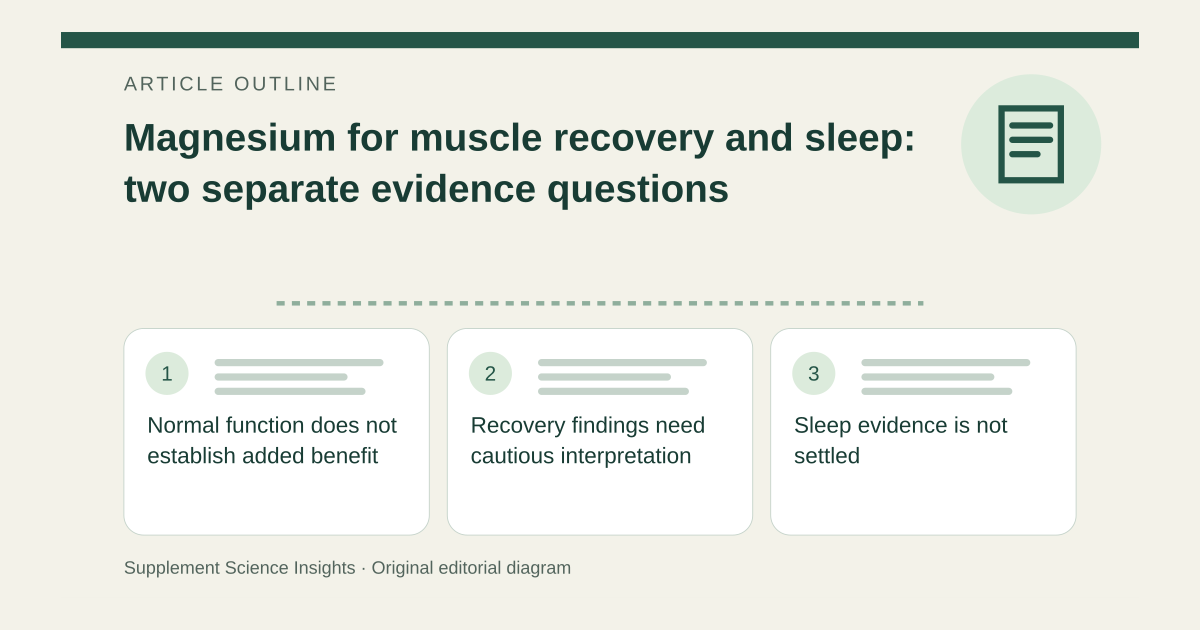
Normal function does not establish added benefit
Meeting magnesium needs supports normal physiology. Whether extra magnesium improves post-exercise recovery or sleep in someone already adequately supplied requires outcome studies. Deficiency correction and enhancement of normal performance are different questions. [1][2]
Recovery findings need cautious interpretation
A 2024 systematic review included four studies and 73 young adults. Different preparations, timing and outcome measures limit confidence in a standard protocol. Soreness, strength, exercise performance and recovery time are related but not interchangeable outcomes. [3]
Sleep evidence is not settled
NCCIH describes limited high-quality research on magnesium for insomnia. A person reporting relaxation does not establish improved sleep duration, insomnia treatment or next-day function. Recovery studies cannot fill that evidence gap simply because sleep contributes to recovery. [4]
One bedtime formula does not solve both questions
Check the actual ingredients and elemental magnesium rather than relying on a recovery-and-sleep label. The US adult upper limit of 350 mg daily applies to magnesium from supplements and medicines, not food; it is not a recommended recovery dose. Kidney impairment and medicine interactions require particular care. [1]
Measure the outcome that prompted use
Imagine an exerciser changes training load, bedtime routine and a supplement at once. Less soreness and better sleep cannot be attributed to magnesium alone. Persistent insomnia, unusual weakness or prolonged exercise pain deserves assessment rather than repeated dose increases. [1][4][3]
| Claim | Relevant outcome |
|---|---|
| Better recovery | Soreness and functional recovery measures |
| Better sleep | Sleep quality, duration and daytime effects |
| Essential mineral | Does not prove an extra-dose benefit |
| One combination product | Needs evidence for its actual formula |
Sources for this article
- Magnesium - Health Professional Fact Sheet
Source consulted: 2026-09-21. This is a reference resource, not a claim that we conducted the studies or tested a product. - The effect of magnesium supplementation on muscle fitness: a meta-analysis and systematic review.
Source consulted: 2026-09-21. This is a reference resource, not a claim that we conducted the studies or tested a product. - Effects of magnesium supplementation on muscle soreness in different type of physical activities: a systematic review - PMC
Source consulted: 2026-09-21. This is a reference resource, not a claim that we conducted the studies or tested a product. - Sleep Disorders and Complementary Health Approaches: Usefulness and Safety | NCCIH
Source consulted: 2026-09-21. This is a reference resource, not a claim that we conducted the studies or tested a product.