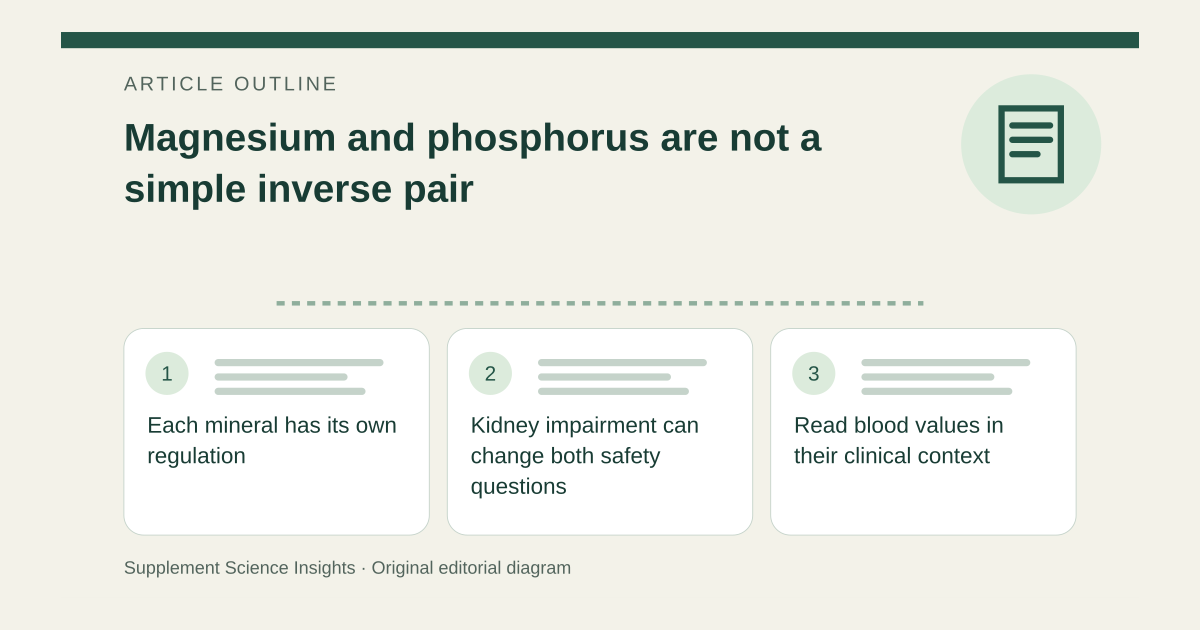
Each mineral has its own regulation
NIH describes the kidneys as central to magnesium balance. Phosphorus balance involves the kidneys, bones and intestines, with hormonal regulation. These systems do not reduce to a universal one-up, one-down rule that can diagnose either level without testing. [1][2]
Kidney impairment can change both safety questions
Reduced kidney function can impair phosphate excretion and raise serum phosphorus. It can also increase the risk from excessive magnesium intake. Assuming high phosphorus must mean low magnesium could therefore lead to an inappropriate supplement decision. [2][1]
Read blood values in their clinical context
Intake, medicines, kidney function and the reason for testing can matter. A result outside a laboratory range needs interpretation with the treating clinician; it is not a reason to self-prescribe an opposing mineral. No fixed magnesium-to-phosphorus supplement ratio follows from these nutrient roles. [1][2]
Do not substitute an arithmetic rule for the second test
Imagine phosphorus is elevated on a blood panel and someone starts magnesium without seeing the magnesium result or reviewing kidney function. That action assumes a relationship the nutrient physiology does not establish. Bring the complete panel and medicine list to the clinician instead. [1][2]
| Finding | What it does not establish |
|---|---|
| High phosphorus | Automatically low magnesium |
| Low magnesium | A fixed phosphorus value |
| Kidney impairment | Safety of unreviewed mineral supplementation |
Sources for this article
- Magnesium - Health Professional Fact Sheet
Source consulted: 2026-09-21. This is a reference resource, not a claim that we conducted the studies or tested a product. - Phosphorus - Health Professional Fact Sheet
Source consulted: 2026-09-21. This is a reference resource, not a claim that we conducted the studies or tested a product.