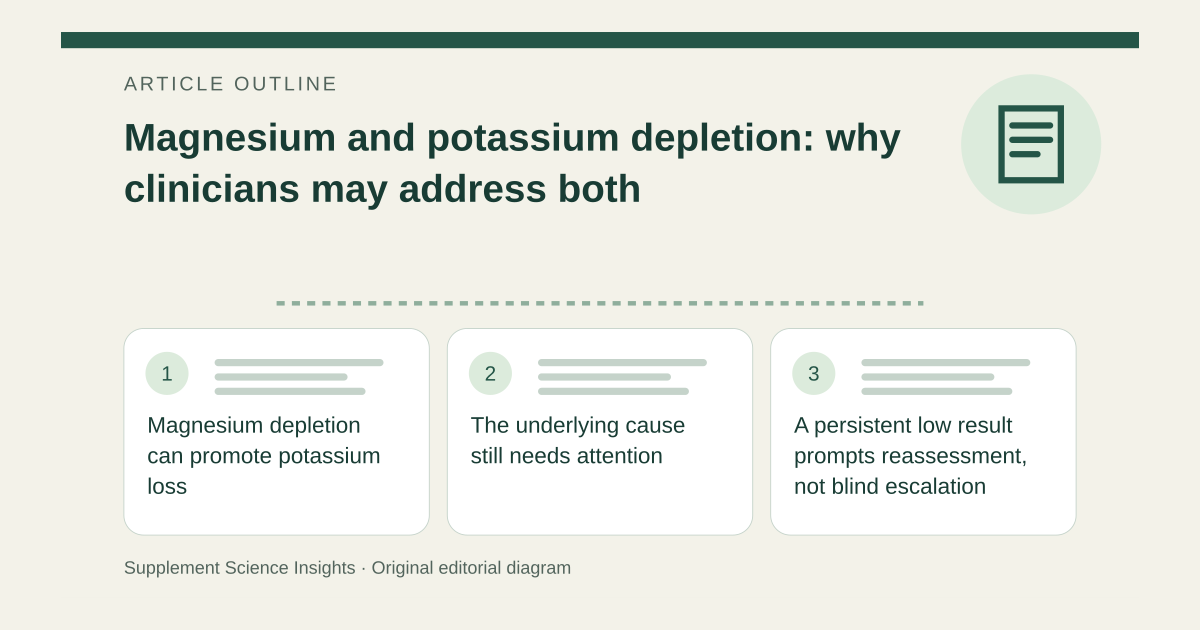
Magnesium depletion can promote potassium loss
The ODS potassium summary explains that magnesium depletion can increase urinary potassium losses and contribute to hypokalemia. When both are low, correcting only the potassium intake may leave a relevant mechanism unaddressed. [1]
The source recommends concurrent treatment of hypomagnesemia and hypokalemia. That is different from a rigid instruction that everyone must take a magnesium product first or wait a fixed time before taking potassium. [1]
The underlying cause still needs attention
Diuretics, gastrointestinal losses and other clinical conditions can contribute to potassium problems. A clinician needs the actual results and health context to determine which abnormalities are present and how to correct them. [1]
The relationship does not prove that a combined supplement is needed by someone with normal levels. Nor does a muscle symptom diagnose depletion of either mineral. Severe electrolyte abnormalities can affect heart rhythm, so the explanation should not be turned into an unsupervised replacement protocol. [1]
A persistent low result prompts reassessment, not blind escalation
Imagine potassium remains low despite a prescribed replacement plan and low magnesium is also found. That additional result may help explain ongoing losses and guide the clinician’s response. It does not supply enough information for an observer to calculate new amounts or choose an intravenous regimen.
| Detail | Interpretation |
|---|---|
| Potassium remains low | Review response and cause |
| Magnesium also low | Potential contributor |
| New dosing decision | Requires clinical assessment |
Sources for this article
- NIH ODS: Potassium
Source consulted: 2026-09-17. This is a reference resource, not a claim that we conducted the studies or tested a product.