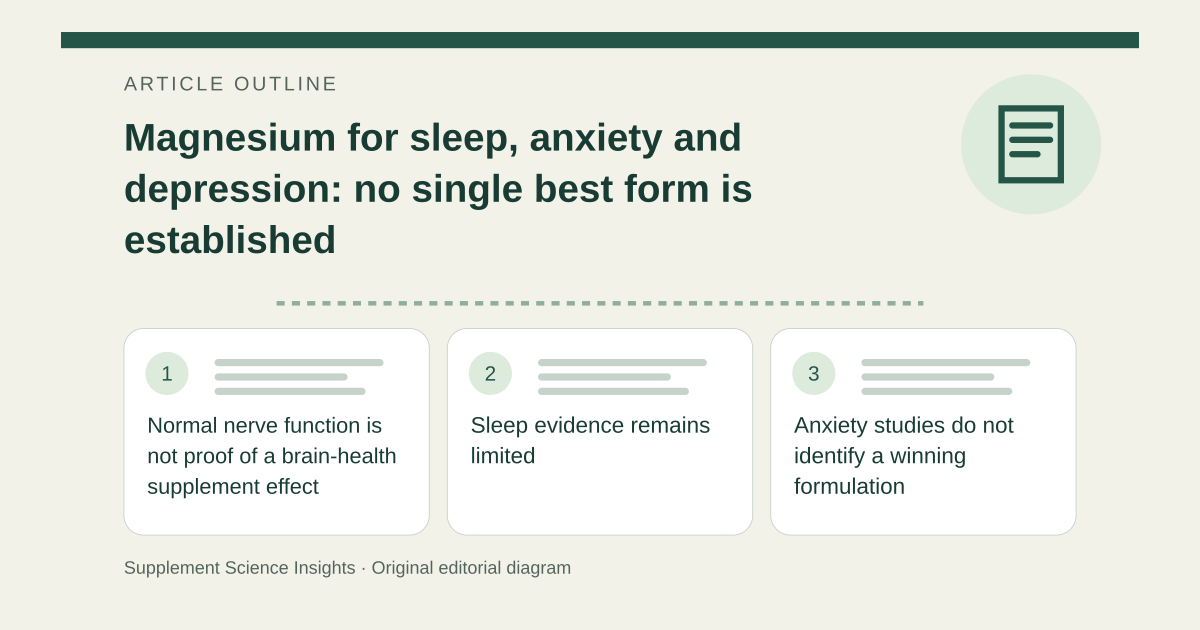
Normal nerve function is not proof of a brain-health supplement effect
NIH describes magnesium’s role in ion transport and nerve signaling. Correcting inadequate status is different from demonstrating better memory, mood or sleep in someone with adequate intake. A brain-health label or an absorption claim does not supply those clinical outcomes. [1]
Sleep evidence remains limited
NCCIH describes little high-quality research on magnesium for insomnia and inconsistent broader findings. A shorter time to fall asleep in a small study is not proof that every person will sleep longer or function better the next day. Persistent sleep difficulty deserves assessment rather than repeated changes of mineral salts. [2]
Anxiety studies do not identify a winning formulation
A 2024 systematic review examined 15 studies involving anxiety or sleep outcomes. Small samples, differing doses, populations and co-ingredients limited generalization, and an optimal magnesium form could not be established. This does not justify ranking glycinate, citrate or oxide as a universal anxiety treatment. [3]
Depression findings are promising but not definitive
A meta-analysis searching through July 2023 pooled seven randomized trials involving 325 adults and found an improvement in depression scores. The authors called for larger, higher-quality trials before applying the result confidently in clinical settings. This review-level finding does not establish a best retail form, a universal dose or a replacement for depression care. [4]
Amount and safety remain separate questions
Count elemental magnesium from supplements and medicines. The adult 350 mg nonfood upper limit is not a sleep or mood-treatment target, and supervised treatment may differ. Diarrhea and other adverse effects can occur; impaired kidney function raises toxicity risk. Review the full regimen rather than assuming a calming label makes it harmless. [1]
Choose a measurable goal instead of a broad promise
Imagine someone wants both better sleep and less anxiety while therapy and work stress are also changing. Track those outcomes separately and review treatment with a clinician. A change in one symptom cannot establish that the supplement treated every concern or that a higher dose would work better. [3][5]
| Goal | Evidence distinction |
|---|---|
| Sleep | Onset, duration and daytime function differ |
| Anxiety | No universally best form established |
| Depression | Small pooled evidence needs confirmation |
| Brain health | Physiological role is not a broad outcome trial |
Does low intake predict who will sleep better?
In the four-week bisglycinate trial in 155 adults reporting poor sleep, the average improvement in self-reported insomnia severity was small. An exploratory analysis suggested larger improvements among participants reporting lower dietary magnesium intake. That finding is a hypothesis about a possible subgroup, not a validated test for selecting responders. [6]
Low reported food intake is not the same as a diagnosis of magnesium deficiency. The study did not establish that everyone with low intake benefits or that lack of improvement rules out low status. Differences between people, small average effects and inconsistent sleep findings help explain why a personal response cannot be promised. [6]
Do anxiety findings prove an effect independent of sleep?
A 2024 review examined trials measuring anxiety and sleep, but only one included study assessed both. Most findings therefore came from separate outcome sets rather than a design that established whether improved sleep caused, mediated or was unrelated to an anxiety change. [7]
The review also found small samples, varied doses and formulations, and some interventions with other active ingredients. An improved anxiety score is not proof that magnesium directly changes mood independently of sleep. Conversely, the evidence does not prove that every anxiety finding is explained by sleep. Those causal questions require studies designed to separate the pathways. [7]
Sources for this article
- Magnesium - Health Professional Fact Sheet
Source consulted: 2026-09-21. This is a reference resource, not a claim that we conducted the studies or tested a product. - Sleep Disorders and Complementary Health Approaches: Usefulness and Safety | NCCIH
Source consulted: 2026-09-21. This is a reference resource, not a claim that we conducted the studies or tested a product. - Examining the Effects of Supplemental Magnesium on Self-Reported Anxiety and Sleep Quality: A Systematic Review - PMC
Source consulted: 2026-09-21. This is a reference resource, not a claim that we conducted the studies or tested a product. - Magnesium supplementation beneficially affects depression in adults with depressive disorder: a systematic review and meta-analysis of randomized clinical trials.
Source consulted: 2026-09-21. This is a reference resource, not a claim that we conducted the studies or tested a product. - Dietary Supplements: What You Need to Know
Source consulted: 2026-09-21. This is a reference resource, not a claim that we conducted the studies or tested a product. - Schuster et al. — Magnesium bisglycinate in adults reporting poor sleep
Source consulted: 2026-10-28. This is a reference resource, not a claim that we conducted the studies or tested a product. - Rawji et al. — Supplemental magnesium, self-reported anxiety and sleep quality
Source consulted: 2026-10-28. This is a reference resource, not a claim that we conducted the studies or tested a product.