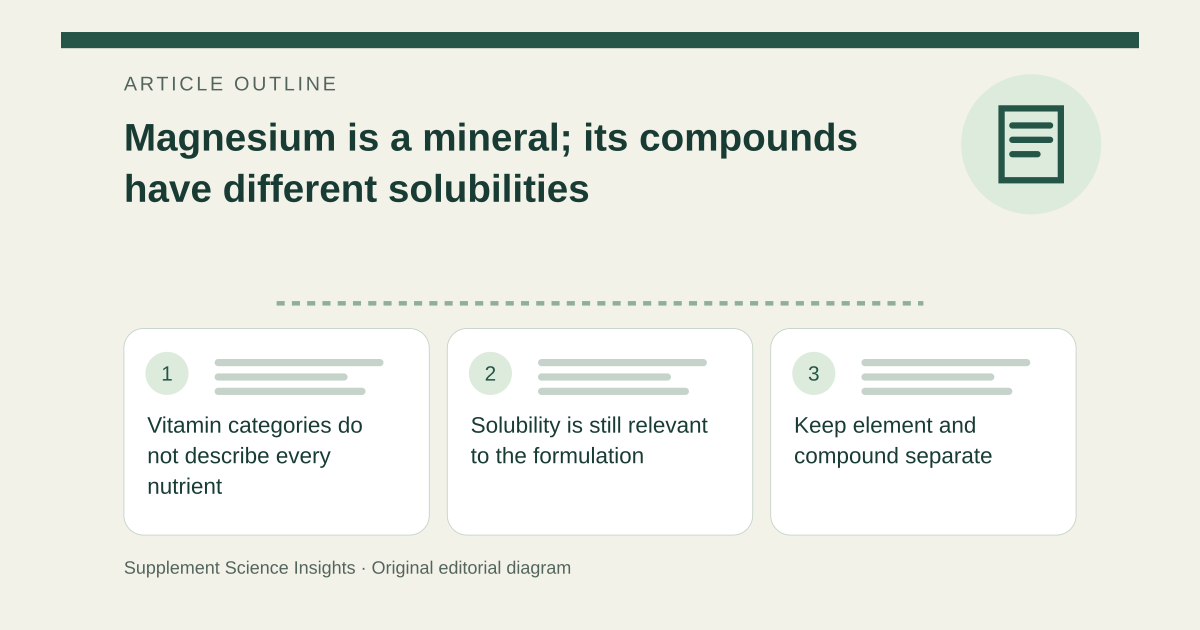
Vitamin categories do not describe every nutrient
Water-soluble and fat-soluble are familiar categories for vitamins. Applying that binary label to magnesium obscures the difference between the element and a formulated salt or other compound. [1]
A label may identify magnesium citrate, oxide or chloride. These names specify forms that contain magnesium, rather than different vitamins. [1]
Solubility is still relevant to the formulation
NIH ODS reports differences in absorption among forms, with more readily dissolved forms generally absorbed more completely than less soluble ones. This is a formulation property, not a new vitamin classification. [1]
The label’s elemental magnesium amount remains distinct from the weight of the whole compound. Neither dissolution nor a larger compound weight automatically establishes a superior clinical effect. [1]
Keep element and compound separate
Imagine two products list equal elemental magnesium but different source compounds. The amounts can match even though dissolution properties differ.
| Detail | Interpretation |
|---|---|
| Magnesium | Mineral element |
| Source compound | Has physical properties |
| Vitamin category | Different classification |
Sources for this article
- Magnesium - Health Professional Fact Sheet
Source consulted: 2026-09-18. This is a reference resource, not a claim that we conducted the studies or tested a product.