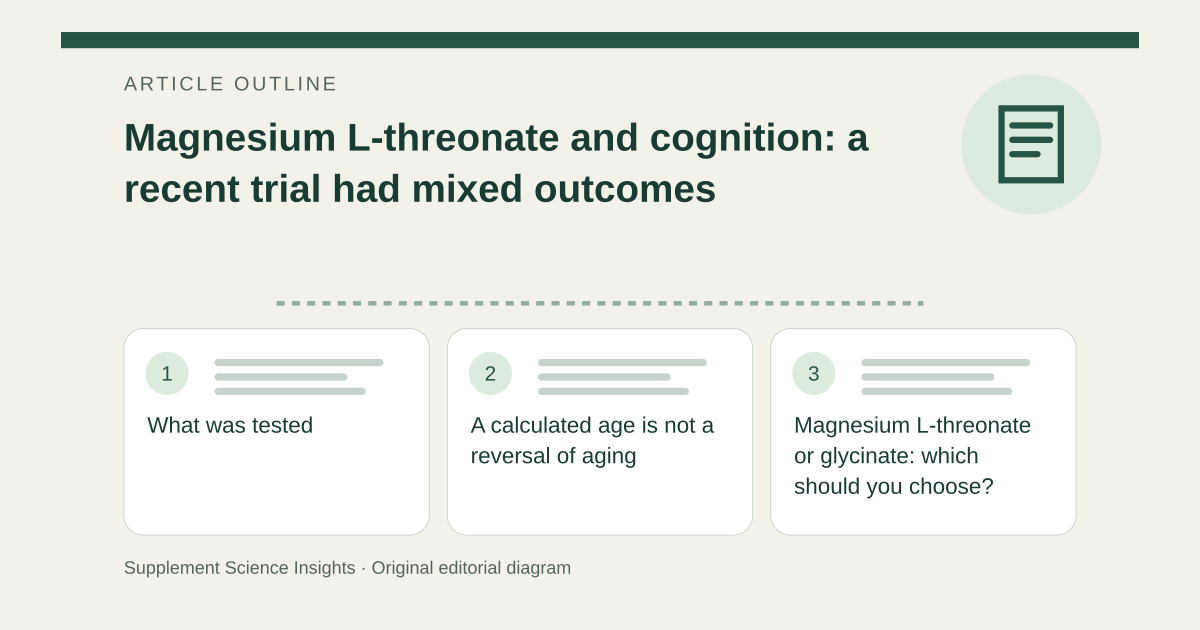
What was tested
One hundred adults aged 18 to 45 with dissatisfied sleep received magnesium L-threonate or placebo in a randomized, double-blind study. After six weeks, the supplement group improved more on the NIH total cognition composite and reaction time, while the Raven’s test did not show a between-group difference. [1]
Some subjective sleep-related impairment improved, but wearable-measured sleep outcomes did not differ between groups. Selecting only the favorable endpoints would give an incomplete account. [1]
A calculated age is not a reversal of aging
The reported reduction in estimated cognitive age came from test performance. It does not demonstrate younger brain tissue, dementia prevention or a lasting change in biological aging. The trial also did not establish superiority over other magnesium forms. [1]
Threotech funded the study, supplied the product and participated in design conceptualization. The investigators disclosed employment or leadership in a research organization receiving nutraceutical funding. These interests and the short duration make independent replication important. [1]
Magnesium L-threonate or glycinate: which should you choose?
The cognition trial discussed here compared L-threonate with placebo, not magnesium glycinate. It therefore cannot establish that L-threonate is the better magnesium choice for memory, sleep or routine nutritional intake. A glycinate label likewise does not establish those benefits merely because glycine is part of its chemical name. [2][3]
For a nutritional comparison, start with elemental magnesium per serving, the number of capsules or scoops, tolerance and the reason for supplementing. Do not compare the large weight of a threonate complex with the smaller elemental-magnesium number on another label. Paying more for L-threonate is a preference for that preparation, not a proven head-to-head clinical advantage over glycinate. [2][3]
Separate a score from a physical change
Imagine a test score maps to a younger reference age after treatment. That does not mean a scan or long-term follow-up has shown reversal of brain aging.
| Detail | Interpretation |
|---|---|
| Six weeks | Short follow-up |
| Cognitive age estimate | Derived from performance |
| Sleep findings | Subjective and wearable results differed |
Sources for this article
- The effects of magnesium L-threonate (Magtein®) on cognitive performance and sleep quality in adults: a randomised, double-blind, placebo-controlled trial - PubMed
Source consulted: 2026-09-19. This is a reference resource, not a claim that we conducted the studies or tested a product. - NIH ODS: Magnesium
Source consulted: 2026-09-25. This is a reference resource, not a claim that we conducted the studies or tested a product. - Magnesium L-threonate cognition and sleep randomized trial, PMID 41601871
Source consulted: 2026-09-25. This is a reference resource, not a claim that we conducted the studies or tested a product.