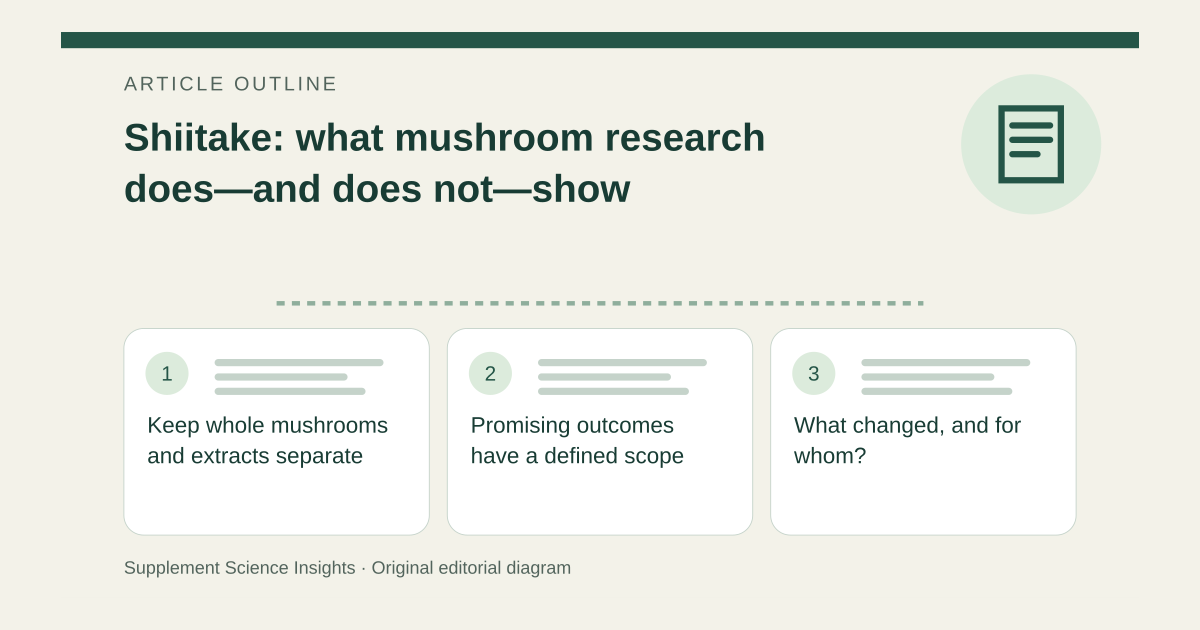
Keep whole mushrooms and extracts separate
Shiitake is eaten fresh or dried and also appears in extract research. MSK discusses whole mushrooms, mycelial extracts and lentinan, an isolated polysaccharide. These descriptions identify different research materials. A finding about one should not be transferred to every product that uses the shiitake name. [1]
Promising outcomes have a defined scope
MSK summarizes small human studies of immune function and metabolic outcomes, as well as selected adjunctive cancer-care studies. It concludes that better studies are needed to establish usefulness alongside cancer treatment. Research on an additional treatment is not evidence that mushrooms can replace the underlying treatment. [1]
What changed, and for whom?
An immune-function result does not by itself tell you whether participants had fewer infections. A microbiome result does not automatically show less pain or better digestion. To judge a claim, keep the measured outcome in the sentence and avoid replacing it with a broader benefit.
Imagine a product page citing a study in people receiving a specific cancer regimen. Even a favorable result would leave questions about people without cancer, a different regimen and a different extract. Those are questions for additional evidence, not details to remove because the headline becomes less compelling.
| Information presented | What it establishes | What remains unanswered |
|---|---|---|
| Whole mushrooms in a meal | A food exposure | Equivalence to an isolated fraction |
| A mycelial extract in a trial | One tested preparation | Effects of another extract |
| A lentinan finding | Evidence about that material | Benefit from any shiitake bottle |
Rash reports should not be dismissed
MSK describes a distinctive streaked rash after shiitake consumption, including reports involving cooked mushrooms. It also lists allergic reactions and gastrointestinal effects. These are reports of possible harms, not estimates of how frequently an ordinary meal will cause a reaction. Cooking should not be presented as a guarantee against every reported reaction. [1]
A useful conversation starts with the actual exposure
If a rash or other suspected reaction occurs, tell a health professional what was eaten or taken, when it happened and whether it was a food, powder or extract. That information is more useful than the general statement that a “mushroom product” was involved. A history of allergy also belongs in a discussion before using concentrated preparations. [1]
Choose the question before the product
Eating shiitake for its culinary qualities and buying an extract to change a health outcome are separate choices. For the latter, identify the desired outcome first. Then look for a study that tests it using a comparable preparation. A long ingredient list or a high stated extract ratio does not answer that clinical question.
This page does not recommend a shiitake supplement. The references explain the research categories and reported cautions; they do not establish an exact match between a retail product and a demonstrated personal benefit.
Sources for this article
- Memorial Sloan Kettering — Shiitake Mushroom
Source consulted: 2026-09-17. This is a reference resource, not a claim that we conducted the studies or tested a product.