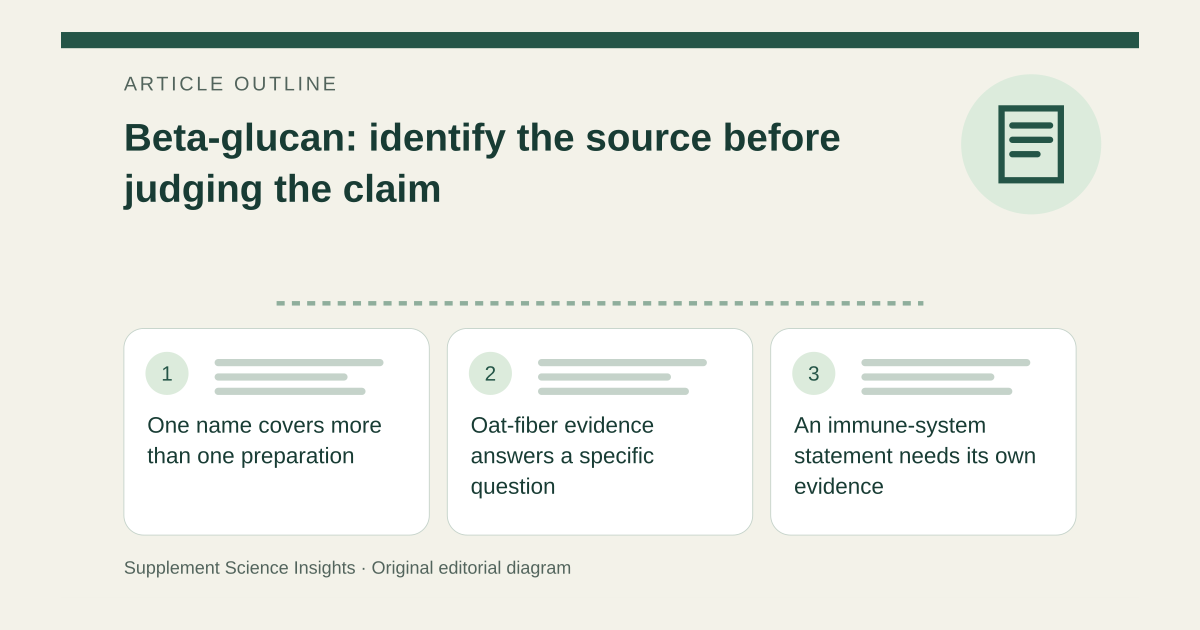
One name covers more than one preparation
Beta-glucans are chains of glucose found in sources including cereals, yeast and mushrooms. The National Cancer Institute's definition describes this broad family, not a single standardized supplement. A source name and a measured amount are therefore important parts of identifying a product. [1]
Seeing beta-glucan on two packages does not establish that the preparations are interchangeable. The useful next question is what kind was studied for the particular outcome being advertised. [1]
Oat-fiber evidence answers a specific question
Health Canada's assessment supports a relationship between eligible oat beta-glucan foods and lower blood cholesterol. The assessment centers on total and LDL cholesterol, and identifies three grams per day of oat beta-glucan in the supporting evidence. That context is not a universal serving recommendation for every beta-glucan supplement. [2]
A cholesterol measurement is a risk-factor outcome. It should not be rewritten as proof that a particular retail capsule prevents heart attacks. The assessment also does not establish that a yeast or mushroom extract reproduces the oat-food result. [2]
An immune-system statement needs its own evidence
The fact that beta-glucans are being investigated in cancer or immune research does not establish an effective cancer treatment or a general protection-from-infection claim. The NCI description identifies a research area, not an endorsement of a consumer supplement. [1][2]
When a seller links several benefits together, examine each link separately. Evidence for an oat food and cholesterol cannot fill a gap in evidence for a mushroom capsule and respiratory illness. The shared ingredient-family name does not connect those outcomes by itself. [1][2]
Keep medical decisions separate from a fiber claim
This overview does not establish the safety of an unidentified beta-glucan extract, its compatibility with medicines or its use during cancer treatment. Discuss those questions with the treating team using the actual ingredient list. Do not replace a prescribed treatment because a source mentions ongoing research. [3]
For food products, check the complete label for ingredients relevant to your dietary restrictions. A highlighted beta-glucan figure does not describe everything else in the food or capsule. [3]
Separate total fiber from beta-glucan
Imagine an oat product declares four grams of total fiber and one gram of oat beta-glucan per serving. Those figures are not additive: the beta-glucan is part of the stated fiber. Two servings would provide eight grams of total fiber, including two grams of beta-glucan.
A different product that states only four grams of fiber has not disclosed the same beta-glucan amount. The missing detail should remain unknown rather than being estimated from the total fiber line. Write the source beside the amount so an oat-food figure is not later confused with an unrelated extract.
| Hypothetical oat label | One serving | Two servings |
|---|---|---|
| Total fiber | 4 g | 8 g |
| Oat beta-glucan, included in total | 1 g | 2 g |
Sources for this article
- National Cancer Institute — Beta-glucan Definition
Source consulted: 2026-09-17. This is a reference resource, not a claim that we conducted the studies or tested a product. - Health Canada — Oat Products and Blood Cholesterol Lowering
Source consulted: 2026-09-17. This is a reference resource, not a claim that we conducted the studies or tested a product. - NCCIH — Using Dietary Supplements Wisely
Source consulted: 2026-09-17. This is a reference resource, not a claim that we conducted the studies or tested a product.