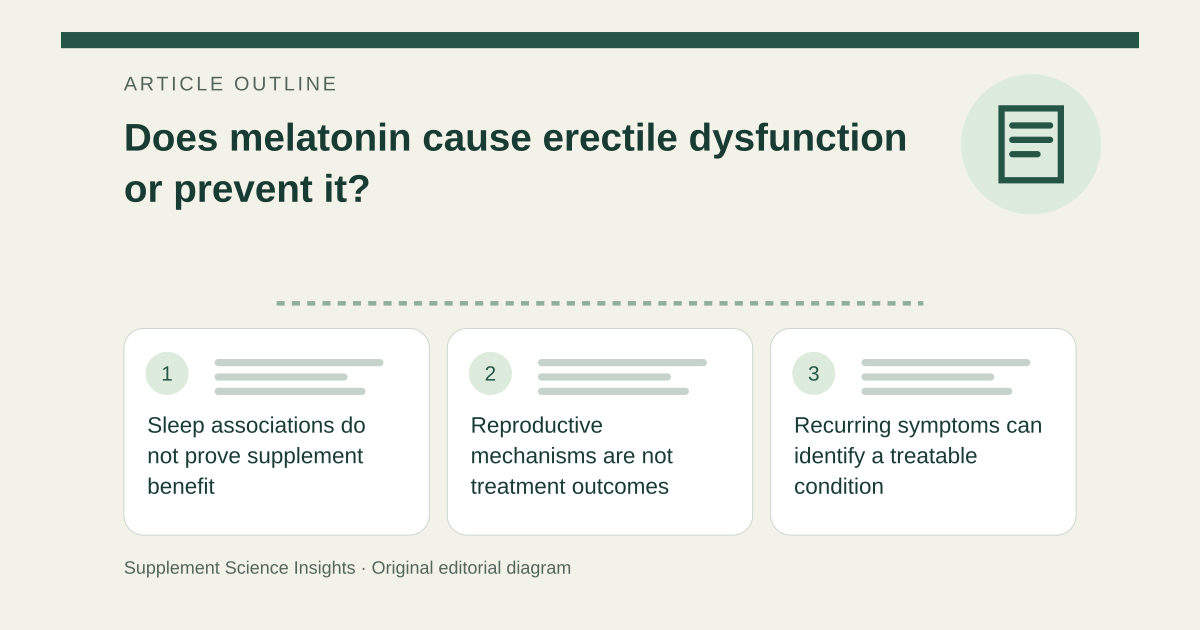
Sleep associations do not prove supplement benefit
A review links short sleep and erectile dysfunction through proposed neuroendocrine and molecular pathways, while emphasizing uncertainty about mechanisms. An association between sleep problems and erectile function does not demonstrate that taking melatonin corrects the problem. [1]
Reproductive mechanisms are not treatment outcomes
Melatonin is studied in reproductive physiology, often in experimental settings. The reviewed reproductive literature identifies uncertainty in humans. Hormonal or antioxidant mechanisms alone cannot establish prevention of erectile dysfunction or a clinically effective dose. [2]
Recurring symptoms can identify a treatable condition
NHS lists factors including stress, tiredness, alcohol, some medicines, diabetes, vascular risk and hormone problems. Repeated difficulty getting or keeping an erection warrants assessment. Established options depend on the cause and include prescribed treatments and psychological support where appropriate. [3]
Review a new symptom without assuming causation
Imagine erectile difficulties begin after a sleep supplement is added during a stressful period. Bring the timeline and all medicines to the clinician. Do not increase melatonin to chase a proposed mechanism or stop another prescribed medicine without advice. [3][2]
| Finding | What it does not prove |
|---|---|
| Poor sleep and ED overlap | Melatonin treats ED |
| Experimental hormone effect | Predictable human harm |
| Symptom after a supplement | Certain causation |
| Persistent ED | A problem to ignore |
Sources for this article
- Short Sleep Duration and Erectile Dysfunction: A Review of the Literature.
Source consulted: 2026-09-21. This is a reference resource, not a claim that we conducted the studies or tested a product. - Melatonin biosynthesis and regulation in reproduction.
Source consulted: 2026-09-21. This is a reference resource, not a claim that we conducted the studies or tested a product. - Erectile dysfunction (impotence) - NHS
Source consulted: 2026-09-21. This is a reference resource, not a claim that we conducted the studies or tested a product.