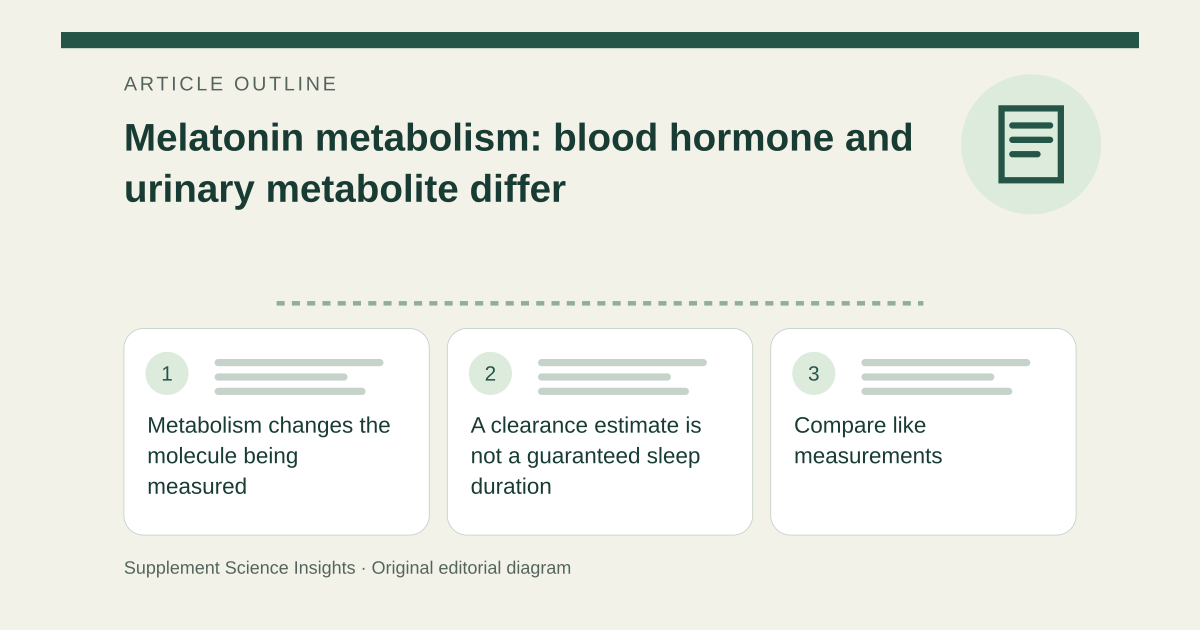
Metabolism changes the molecule being measured
Endotext describes liver conversion to 6-hydroxymelatonin, mainly through CYP1A2, followed by conjugation and urinary excretion as 6-sulfatoxymelatonin. These are related but distinct chemical entities. [1]
Urinary measurements can provide information about secretion patterns, but the collection interval and metabolic delay matter. They are not an instantaneous readout of a single blood concentration. [1]
A clearance estimate is not a guaranteed sleep duration
The source describes a short blood half-life in its physiological account. That does not establish how long every oral formulation produces effects, particularly when its release characteristics differ. [1]
Sample type, timing and the actual preparation should remain attached to any interpretation. Do not use a generic half-life to decide that driving or another demanding activity is necessarily unaffected. [1]
Compare like measurements
Imagine a urine sample covers several overnight hours while a blood sample was taken once. Their values and timing cannot be compared as if they measured the same moment.
| Detail | Interpretation |
|---|---|
| Blood melatonin | Hormone concentration |
| Urinary metabolite | Processed excretion signal |
| Collection timing | Part of interpretation |
Sources for this article
- Physiology of the Pineal Gland and Melatonin - Endotext - NCBI Bookshelf
Source consulted: 2026-09-18. This is a reference resource, not a claim that we conducted the studies or tested a product.