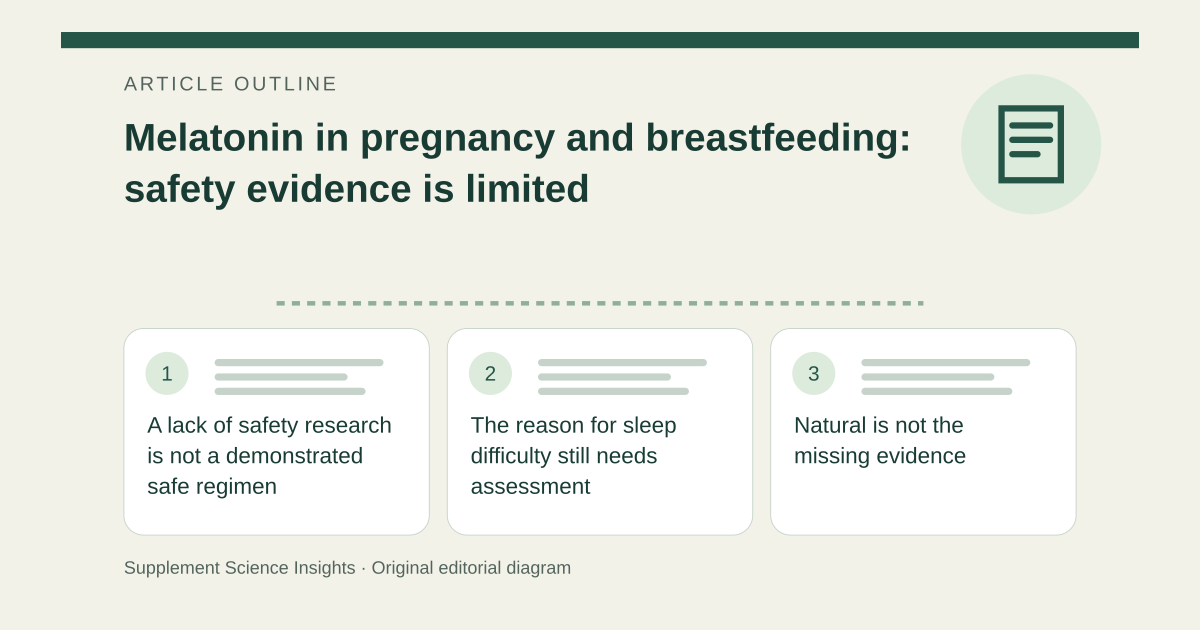
A lack of safety research is not a demonstrated safe regimen
NCCIH states that research on melatonin supplement safety in pregnant or breastfeeding people is lacking. That does not establish that harm always occurs, but it also does not support a general assurance of safety. [1]
Findings in other adults cannot fill this gap automatically. Pregnancy and breastfeeding are specific contexts, and supplement exposure is not identical to the hormone normally produced in the body. [1]
The reason for sleep difficulty still needs assessment
A sleep complaint does not itself identify a melatonin deficiency or show that a supplement will address its cause. The NCCIH discussion distinguishes several sleep conditions and their evidence. [1]
Discuss the sleep problem, medicines and any supplement under consideration with the prenatal or breastfeeding care team. This page does not choose a replacement sleep aid or a safe interval around feeding. [1]
Natural is not the missing evidence
Imagine a label calls a product a natural sleep hormone. That statement does not provide data about the proposed amount, repeated use or outcomes during pregnancy or breastfeeding.
A useful question asks what evidence applies to that setting, rather than using the presence of endogenous melatonin as proof that an added dose is suitable.
| Detail | Meaning |
|---|---|
| Melatonin exists naturally | A physiological fact |
| Healthy-adult short-term studies | A different population |
| Safety during pregnancy or breastfeeding | Requires relevant evidence |
Do not invent a reassuring threshold
The source does not provide a universally safe supplement dose for pregnancy or lactation. A smaller amount cannot be declared proven safe simply because a larger amount seems less appealing. [1]
Potential sleepiness and medicine interactions also remain relevant. This is an explanation of the evidence gap, not a claim that melatonin is invariably harmful or a personal treatment recommendation. [1]
Sources for this article
- NCCIH: Melatonin—What You Need To Know
Source consulted: 2026-09-17. This is a reference resource, not a claim that we conducted the studies or tested a product.