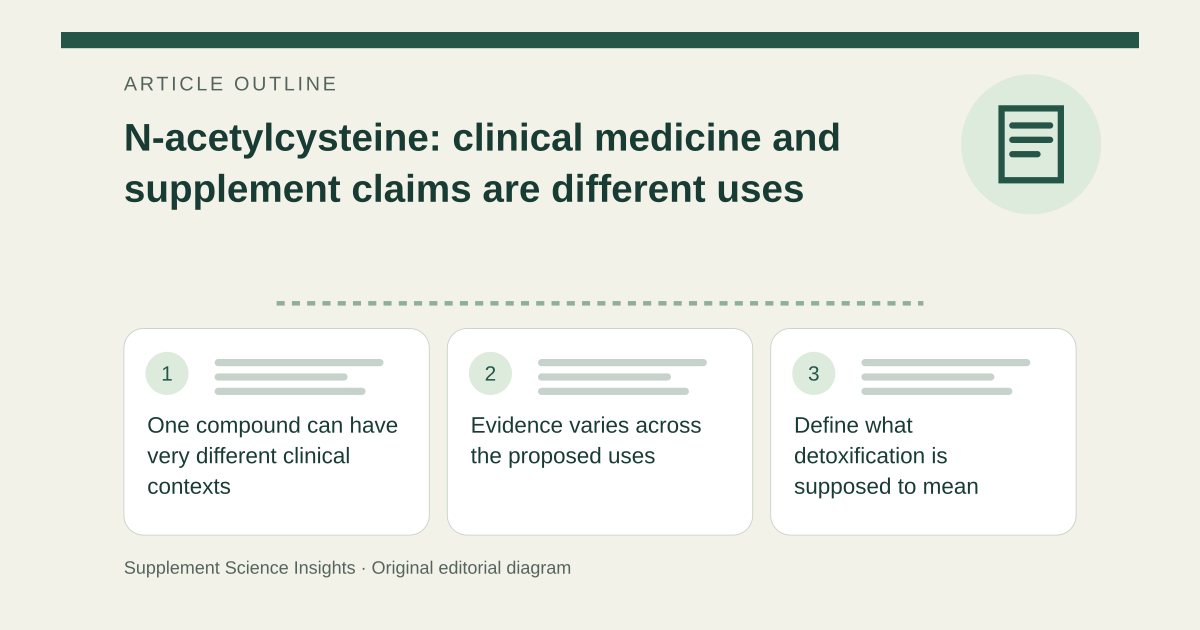
One compound can have very different clinical contexts
N-acetylcysteine, usually abbreviated NAC, is used in medicines and sold in supplements. It is a precursor involved in glutathione production. Clinical preparations have specific routes, indications and supervision that do not transfer automatically to a retail capsule. [1]
Its medical use for acetaminophen poisoning is not a home-treatment instruction. Suspected poisoning needs urgent professional care; a supplement label cannot supply the assessment, timing or regimen required for that situation. [1]
Evidence varies across the proposed uses
Memorial Sloan Kettering describes mixed findings for chronic lung and psychiatric conditions. Some research involves NAC as an addition to existing treatment, which is different from replacing that treatment. [1]
NAC has not established a general cancer-prevention benefit. Nor does its role in glutathione biology prove that routine supplementation removes unspecified toxins or improves every immune outcome. The proposed condition, actual preparation and measured endpoint determine what a study can support. [1]
Define what detoxification is supposed to mean
A useful claim would name the substance, the exposure, the measurement and the health outcome. Without those details, detoxification is too vague to evaluate. Increasing a biochemical precursor is not the same as showing fewer symptoms, less organ damage or better long-term health.
A study conducted during a defined toxic exposure also cannot establish routine benefit in people without that exposure. This distinction prevents a valid clinical use from becoming an unlimited marketing claim. The same ingredient name does not make the clinical problem or treatment context equivalent.
Route and co-treatment affect the adverse-event picture
Oral NAC can cause gastrointestinal symptoms such as nausea, vomiting or diarrhea. Other routes and clinical preparations have different risks. NAC can intensify nitroglycerin-related headache through an added vasodilating effect. [1]
During cancer treatment, discuss antioxidant supplements with the oncology team because effects on treatment remain uncertain. A small study's tolerability does not establish safety for every combination or duration. This page does not advise modifying a prescribed medicine or using a supplement to manage an overdose. [1]
An add-on trial does not test replacement
Imagine a fictional lung-disease study gives all participants usual treatment and adds NAC only to one group. Even if that group has fewer exacerbations, the finding concerns NAC added to the existing care.
It does not show that NAC alone performs better than the medicines everyone received. A fair table keeps the common background treatment visible and identifies the outcome and observation period.
| Hypothetical trial | Correct scope |
|---|---|
| Usual care in both groups | Background treatment retained |
| NAC added to one group | Add-on question |
| Replacement never tested | No replacement conclusion |
A legitimate medical role has a defined scope
NAC deserves an evidence description that preserves route, indication and background treatment. This overview does not recommend a detox regimen or a replacement for psychiatric or respiratory care. Its normal biochemical role and specialized medical uses do not establish every supplement claim.
Sources for this article
- Memorial Sloan Kettering — N-acetylcysteine
Source consulted: 2026-09-17. This is a reference resource, not a claim that we conducted the studies or tested a product.