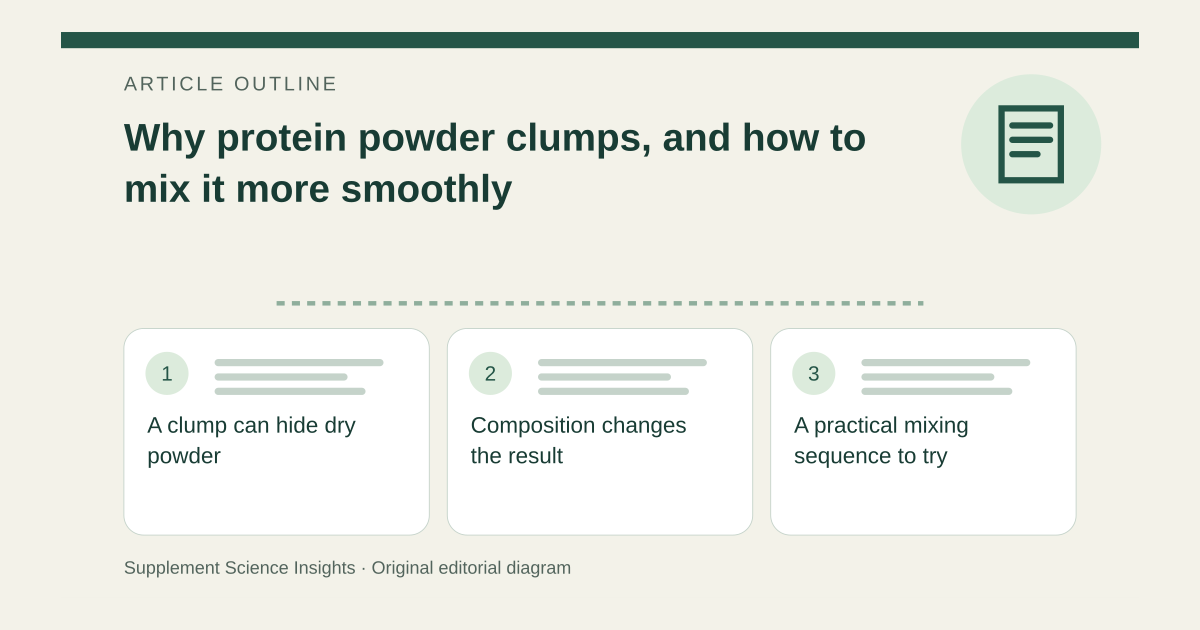
A clump can hide dry powder
Putting protein powder into liquid does not guarantee that every particle becomes wet immediately. Powder may float, stick together or develop a wet outside while material inside an aggregate remains poorly wetted. Breaking up that aggregate and allowing water to reach the particles are different tasks from dissolving the protein. [1]
Food scientists distinguish wettability, dispersibility and solubility. A powder can perform well in one of these stages and poorly in another. That is why a smooth surface or a few seconds of shaking does not always mean complete rehydration. [1]
Composition changes the result
An original milk-protein-concentrate study compared five powders with different protein contents, using laboratory measurements performed in triplicate. Higher-protein formulations generally showed more difficult wetting and dispersion under the tested conditions. The study used water and controlled mixing, not every flavored retail powder mixed into milk. [1]
It demonstrates that formulation matters, but it does not establish one ideal kitchen method. Milk, added thickeners, powder storage and a blender's mixing action create a different system. A clump is not, by itself, proof of a superior protein or a contaminated product. [1]
A practical mixing sequence to try
Start with the product's stated liquid amount and directions. As a practical approach, place the liquid in the container first, add powder gradually and mix so that new powder reaches moving liquid rather than piling onto a dry mass. A shaker insert, whisk or blender may help disperse stubborn aggregates. [1]
If the mixture remains too thick, additional liquid may help, within the intended recipe. A brief pause followed by another mix can allow more wetting. These are practical formulation-based suggestions, not a claim that the cited experiment tested this exact household sequence or that every powder will become completely soluble. [1]
Keep a mixing problem separate from a storage problem
Follow storage directions and keep the scoop and container dry. Do not treat vigorous blending as a way to rescue a product with an unusual odor, visible spoilage or a compromised package. Rehydration performance and food quality are separate questions. [1]
The study was funded through Ireland's Department of Agriculture, Food and the Marine research program; the authors declared no conflicts. Its value here is explaining powder behavior, not demonstrating nutritional or clinical superiority. [1]
A hypothetical troubleshooting comparison
Imagine the same measured scoop mixed first with the labeled volume and then, in a separate preparation, with more liquid. If the second disperses more easily, the result concerns that preparation's texture. The scoop still contains the same declared protein amount; dilution has changed concentration, not added protein. [1]
| Observation | Question to test |
|---|---|
| Dry islands on the surface | Is the powder getting wetted? |
| Wet lumps throughout | Is mixing dispersing the aggregates? |
| Very thick drink | Is there enough liquid for this formulation? |
Sources for this article
- Milk Protein Concentrate Composition and Rehydration — original study (2020)
Source consulted: 2026-09-20. This is a reference resource, not a claim that we conducted the studies or tested a product.