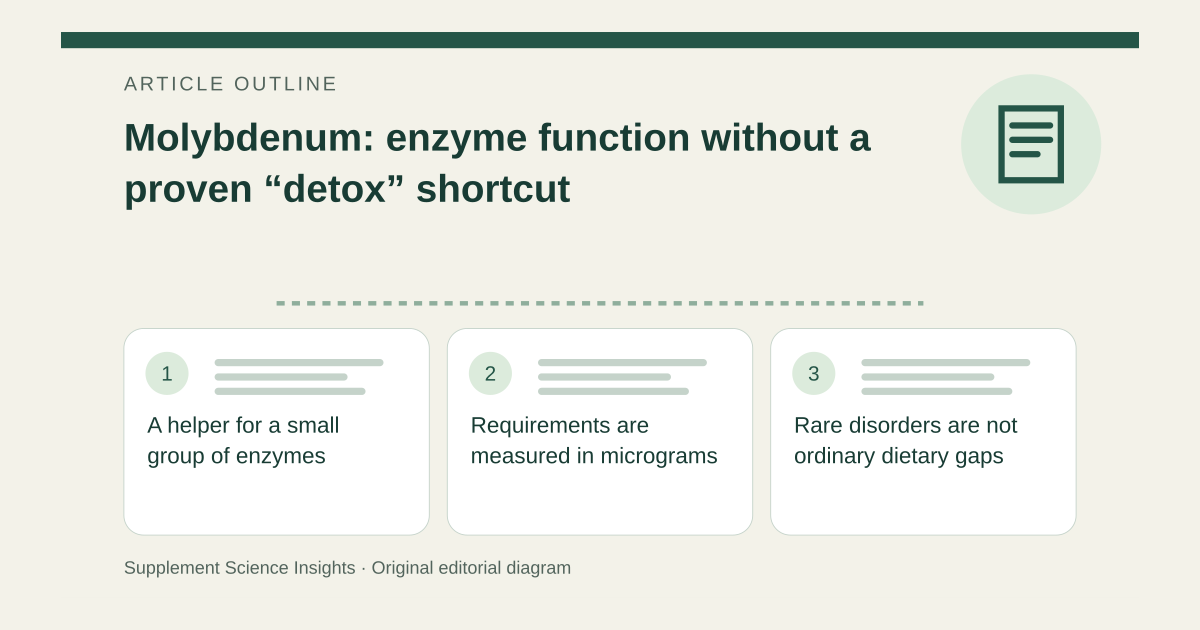
A helper for a small group of enzymes
Molybdenum is part of a cofactor used by enzymes including sulfite oxidase, xanthine oxidase and aldehyde oxidase. These enzymes participate in specific metabolic reactions. That biology does not establish that taking additional molybdenum improves a general “detoxification” process in a well-nourished person. [1]
A marketing phrase can make several different problems sound like one. A suspected exposure, a food reaction and a diagnosed enzyme disorder need different assessments; a shared reference to metabolism does not make the same supplement appropriate for all three. [1]
Requirements are measured in micrograms
The U.S. recommended dietary allowance for adults is 45 mcg per day, rising to 50 mcg during pregnancy and breastfeeding. Legumes, grains, nuts, dairy foods and other foods can contribute. The amount in plants varies with soil and growing conditions. [2]
Most people get enough from food. A precise-looking supplement number should therefore be interpreted alongside existing intake, rather than treated as evidence of a common deficiency. Nutritional requirements are not an argument for taking a much larger amount. [2]
Rare disorders are not ordinary dietary gaps
Molybdenum cofactor deficiency is a rare inherited disorder affecting the body's ability to make the cofactor. It should not be described as an everyday mineral shortage that an over-the-counter capsule can correct. NIH also describes a historical acquired deficiency during molybdenum-free intravenous nutrition. [1]
These unusual clinical circumstances do not establish that fatigue, headache or sensitivity to foods identifies low molybdenum. A symptom-based sales questionnaire cannot distinguish a metabolic disorder from unrelated causes. [1]
There is no established general treatment role
NIH does not describe molybdenum as a standard treatment for disease. Supplemental forms include molybdate and several mineral complexes, but comparative bioavailability evidence is lacking. A chelated form name should not be translated into a proven clinical advantage. [1][2]
The U.S. adult upper limit is 2,000 mcg daily from all sources. It is a protective boundary, not a target or a promise that every lower amount benefits the user. Absence of a demonstrated need remains relevant even when a dose is below a published ceiling. [1][2]
A decimal can change the apparent comparison
Imagine Label A declares 100 mcg molybdenum and Label B declares 0.1 mg per serving. Because 1 mg equals 1,000 mcg, these are the same mass. Neither provides one thousand times more simply because the printed numbers look different.
If a mineral blend gives only a total of 100 mg, there is no basis for entering that as molybdenum. Record its individual amount as unknown. These examples concern declarations and units, not tested products or a recommended daily amount.
| Label | Equivalent mass |
|---|---|
| A: 100 mcg | 0.1 mg |
| B: 0.1 mg | 100 mcg |
| Undisclosed mineral blend | Individual amount unknown |
Ask what outcome the claim promises
A useful claim must say more than “supports detox.” Ask which exposure or condition is meant, what outcome was measured and whether people like the intended user were studied. A diagram showing sulfite metabolism is not a clinical trial.
For routine nutrition, food intake is the starting point. For a suspected poisoning or metabolic disorder, appropriate medical assessment takes priority. This overview explains the nutrient and the evidence boundary without assigning a diagnosis or selecting a supplement regimen.
Sources for this article
- NIH ODS — Molybdenum, professional fact sheet
Source consulted: 2026-09-17. This is a reference resource, not a claim that we conducted the studies or tested a product. - NIH ODS — Molybdenum, consumer fact sheet
Source consulted: 2026-09-17. This is a reference resource, not a claim that we conducted the studies or tested a product.