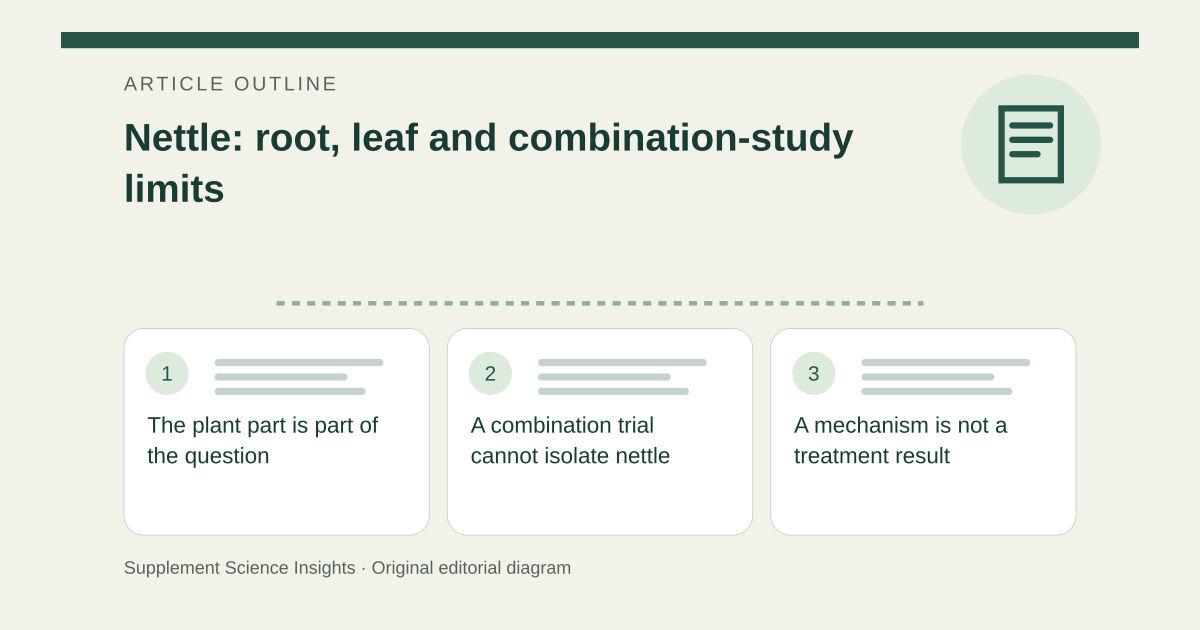
The plant part is part of the question
Nettle appears in several traditional uses. MSK describes limited human studies concerning joint symptoms, benign prostate-related urinary symptoms and glucose control. Root preparations and combinations with other herbs appear in this literature. A reference to “nettle” alone is not enough to identify what a study actually tested. [1]
A combination trial cannot isolate nettle
Suppose a trial compares a preparation containing nettle and saw palmetto against placebo. If the combination performs better, that supports a conclusion about the tested combination. It does not show how much nettle contributed, whether nettle alone would work or whether another blend would have the same effect.
The missing comparison matters. To isolate an ingredient, the study needs a design that separates its contribution from the other ingredients and from the background care. A retailer listing the same two plant names has not demonstrated that its preparation reproduces the trial.
| Claim or observation | What can be concluded | What cannot be assumed |
|---|---|---|
| Nettle plus another herb was studied | The combination was tested | Nettle alone caused the result |
| The paper identifies root extract | A specific plant part | A leaf product is equivalent |
| A laboratory pathway changes | A possible mechanism | Seasonal symptoms improve |
A mechanism is not a treatment result
MSK discusses laboratory findings relevant to inflammatory and allergy pathways. A laboratory observation does not establish reliable relief of seasonal symptoms in people. Keep that distinction visible when an explanation of how a plant might work is presented as proof that it does work. [1]
Use the label to locate the evidence
For a proposed nettle product, record the plant part, the preparation and any companion ingredients before looking for a relevant study. If a source describes the root but the bottle identifies the leaf, mark the comparison as unresolved. Do not silently treat the difference as unimportant.
The desired outcome also needs to match. Evidence about urinary symptoms does not answer a question about joint pain or allergies. A useful evidence table may therefore contain several separate questions under the same ingredient name, each with a different answer. That is more informative than a single overall score.
Medication effects remain an important uncertainty
MSK reports a hypoglycemia case involving a nettle-containing remedy. It describes possible effects on drug metabolism and potential additive effects with diuretics or blood-pressure medicines, while noting uncertain clinical relevance. Report all ingredients in a blend during a medication review, rather than only the ingredient featured most prominently on the package. [1]
Bring a defined symptom question to care
An ingredient overview does not establish the cause of a symptom or select its treatment. For someone considering nettle, the useful starting point is the symptom they want addressed and what assessment has already occurred. That keeps the discussion tied to a real problem instead of expanding a limited research finding into a universal reason for supplementation.
Sources for this article
- Memorial Sloan Kettering — Nettle
Source consulted: 2026-09-17. This is a reference resource, not a claim that we conducted the studies or tested a product.