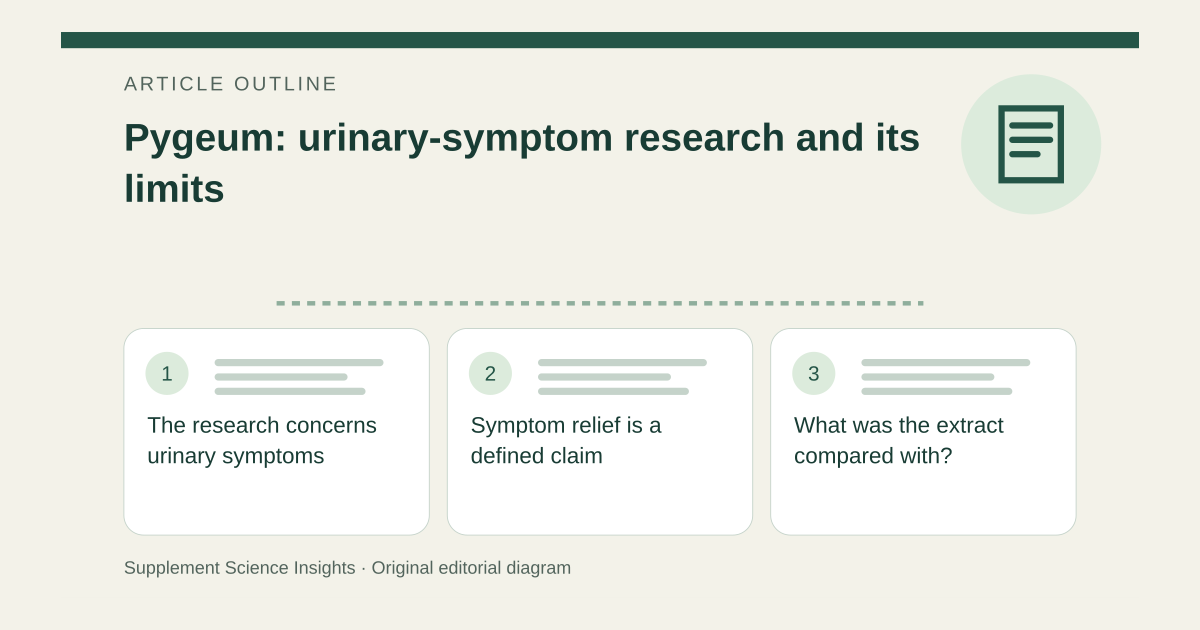
The research concerns urinary symptoms
Pygeum is a bark-derived preparation traditionally used for urinary symptoms associated with benign prostate enlargement. MSK describes clinical findings suggesting symptom improvement, but calls for larger studies comparing pygeum with standard treatments currently used for that condition. That qualification matters when judging a product’s promise. [1]
Symptom relief is a defined claim
A person may care about interrupted sleep, urgency or difficulty passing urine. Those concerns should be named separately when reading a study rather than collected under the broad phrase “prostate health.” A change on a symptom scale answers a narrower question than preventing progression or avoiding a procedure.
For a hypothetical trial reporting an average score, ask how large the difference was, how uncertain it was and whether participants noticed an improvement that mattered to them. Statistical significance alone does not communicate the size or durability of a benefit.
What was the extract compared with?
A placebo-controlled study can help evaluate whether a preparation has an effect beyond its comparison condition. It does not establish that the preparation is as effective as a standard treatment unless that treatment was appropriately compared.
Likewise, a study of several herbs together does not establish the independent effect of pygeum. If the bottle cites a combination trial, the other ingredients, preparation and study conditions belong in the assessment. Removing them changes the question the study answered.
| Claim or observation | What can be concluded | What cannot be assumed |
|---|---|---|
| A symptom score improves | A symptom outcome in that study | Prevention of disease progression |
| A placebo comparison is favorable | An effect relative to placebo | Equivalence to standard treatment |
| Cancer cells respond in a laboratory | A preclinical finding | Cancer prevention in people |
Prostate symptoms and cancer claims must stay separate
MSK describes laboratory work involving prostate cancer cells. Such findings do not establish that pygeum prevents or treats prostate cancer in people. The clinical discussion of benign enlargement should not be repackaged as evidence for a cancer claim. [1]
Tolerability and symptom assessment
MSK lists nausea and gastrointestinal upset among reported adverse effects. Before choosing a supplement for urinary symptoms, discuss the symptoms and current treatment with a health professional. This article does not diagnose benign enlargement from a symptom description or establish a dose for an individual. [1]
A clearer question for a clinician
Bring a short account of what is most bothersome, how long it has been happening and which medicines or supplements you already use. If you have a product in mind, bring its full ingredient panel and the study it cites. The useful decision is whether that evidence addresses your situation, not whether the label uses a familiar prostate-health term.
No pygeum product is selected here. The source supports a cautious overview of the research and its limitations; it does not verify a particular retail preparation against a clinically meaningful benefit.
Sources for this article
- Memorial Sloan Kettering — Pygeum
Source consulted: 2026-09-17. This is a reference resource, not a claim that we conducted the studies or tested a product.