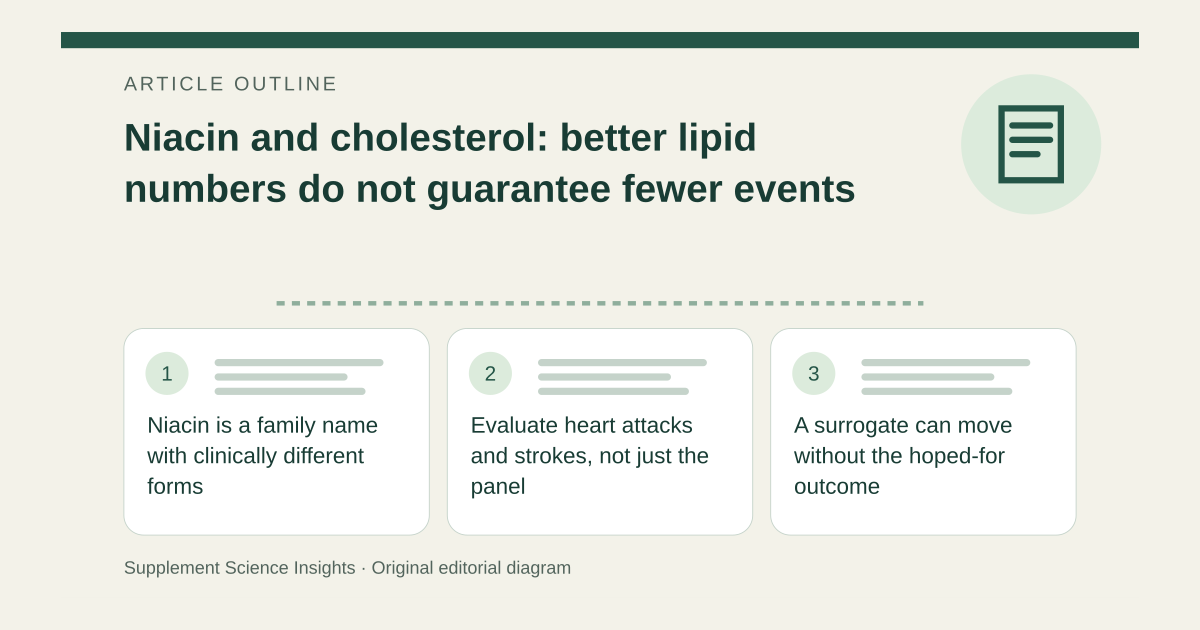
Niacin is a family name with clinically different forms
ODS distinguishes nicotinic acid, which can alter lipid concentrations at pharmacological doses, from nicotinamide, which does not have the same lipid effect. A product marketed as nonflushing therefore should not be assumed to reproduce nicotinic acid’s effects. [1]
These are doses used as treatment, far above ordinary nutritional requirements. Food-level niacin intake and clinician-directed lipid therapy are different interventions. [1]
Evaluate heart attacks and strokes, not just the panel
The ODS review describes trials in which lipid numbers improved without an additional reduction in major cardiovascular events on background statin treatment. Adverse effects also matter, including problems affecting glucose control and tolerability. [1][2]
The 2026 multisociety dyslipidemia guideline likewise states that randomized trials do not support niacin as an add-on to statins for reducing atherosclerotic cardiovascular events. A favorable HDL change alone is insufficient justification for self-treatment. [1][2]
A surrogate can move without the hoped-for outcome
Imagine an intervention raises HDL cholesterol but does not reduce cardiovascular events in the relevant trials. Calling it heart-protective solely from the HDL change leaves out the outcome that motivated treatment. Discuss lipid management using overall risk and established treatment evidence.
| Observation | What it establishes |
|---|---|
| Nicotinic acid | Can change lipids |
| Nicotinamide | Not an equivalent lipid drug |
| Improved panel | Not proof of fewer events |
Sources for this article
- NIH ODS: Niacin
Source consulted: 2026-09-17. This is a reference resource, not a claim that we conducted the studies or tested a product. - 2026 Multisociety Guideline on the Management of Dyslipidemia
Source consulted: 2026-09-17. This is a reference resource, not a claim that we conducted the studies or tested a product.