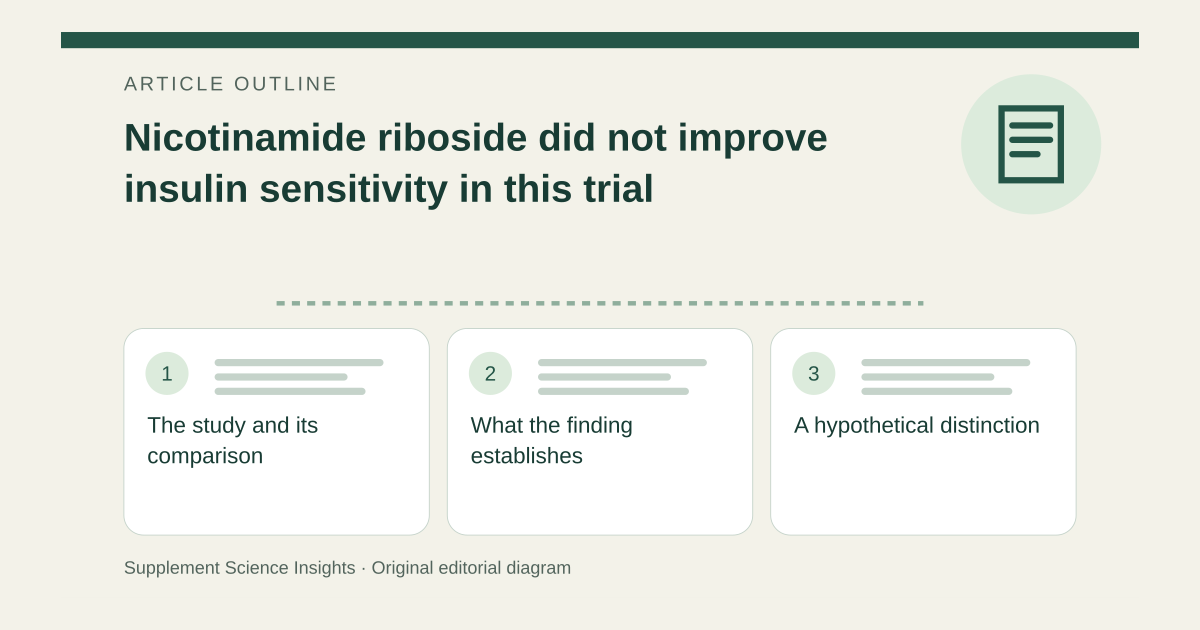
The study and its comparison
Forty sedentary men with obesity and insulin resistance were randomized to nicotinamide riboside or placebo for twelve weeks. The study used a glucose clamp, body-composition imaging and other metabolic measurements. [1]
The tested two-gram daily regimen did not improve insulin sensitivity, glucose production or disposal. Resting energy expenditure, fat metabolism and body composition also did not improve. [1]
What the finding establishes
The findings concern this precursor, regimen and population, rather than all NAD-related interventions. Normal safety blood tests and no treatment-related serious events over twelve weeks do not establish lifelong safety. Funding and conflicts were not established from the abstract. Animal findings should remain separate from measured human outcomes. [1]
A hypothetical distinction
Imagine an appealing cellular pathway motivates a trial but its clinical measurements are null. The pathway does not overturn the trial.
| Detail | Interpretation |
|---|---|
| Measured outcome | Keep the endpoint specific |
| Study preparation | Not every retail product |
| Remaining uncertainty | Not resolved by a mechanism |
Sources for this article
- A randomized placebo-controlled clinical trial of nicotinamide riboside in obese men: safety, insulin-sensitivity, and lipid-mobilizing effects.
Source consulted: 2026-09-19. This is a reference resource, not a claim that we conducted the studies or tested a product.