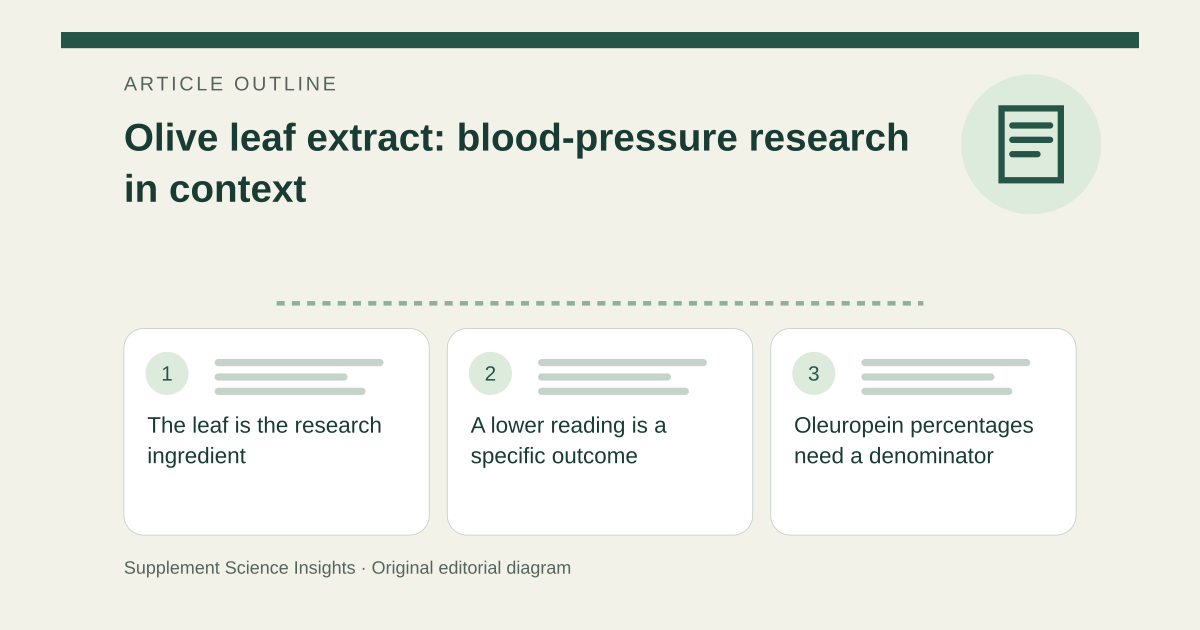
The leaf is the research ingredient
Olive leaf extracts contain compounds including oleuropein. MSK describes small studies suggesting effects on blood pressure and some metabolic measures, with mixed findings for blood lipids. Evidence about leaf extracts should remain attached to those preparations rather than being treated as a general endorsement of all olive-derived products. [1]
A lower reading is a specific outcome
A blood-pressure study and a study of heart attacks answer different questions. Even when a change in a risk marker is useful, it should not be described as a directly observed reduction in clinical events unless those events were measured.
When a claim says “heart health,” ask which outcome supports it. Look for the comparison group, the starting measurements, the duration and the uncertainty around the result. These details help distinguish a small exploratory finding from a conclusion that could reasonably inform care.
Oleuropein percentages need a denominator
A percentage describes composition, not a proven treatment effect. In an invented example, 400 mg of extract standardized to 20% of a named constituent corresponds to 80 mg of that constituent: 400 multiplied by 0.20. That arithmetic does not tell you whether the extract matches a clinical trial, is independently verified or produces a useful outcome.
Nor does a higher calculated amount automatically establish a better choice. Comparing preparations requires the study material and its context, not just the largest number on the front label. If the amount is stated per serving, keep the serving size visible during the comparison.
| Claim or observation | What can be concluded | What cannot be assumed |
|---|---|---|
| 400 mg extract, 20% constituent | 80 mg by label arithmetic | Clinical benefit or verified content |
| Blood pressure measured in a trial | That outcome can be assessed | Fewer heart attacks were demonstrated |
| A topical study is cited | Evidence for that route | The same effect from a capsule |
Do not turn a laboratory effect into infection treatment
MSK discusses antimicrobial and other laboratory findings, plus research using different routes of administration. A topical preparation and an oral capsule are not interchangeable evidence. This overview does not establish olive leaf as a treatment for an infection or cancer. [1]
Review blood-pressure and diabetes medicines
MSK flags possible additive effects with blood-pressure and glucose-lowering medicines, based partly on animal and laboratory evidence; clinical significance remains uncertain. It also notes respiratory allergy associated with olive pollen. A pollen observation is not a frequency estimate for oral-extract reactions. Discuss the exact preparation and medication list with a clinician before use. [1]
What would justify a product comparison?
A useful next step is to find the full study behind the proposed benefit and identify its preparation. Only then can a product be assessed for a plausible match. Where that connection is missing, this page leaves the product question open instead of presenting a preferred bottle.
Sources for this article
- Memorial Sloan Kettering — Olive Leaf
Source consulted: 2026-09-17. This is a reference resource, not a claim that we conducted the studies or tested a product.