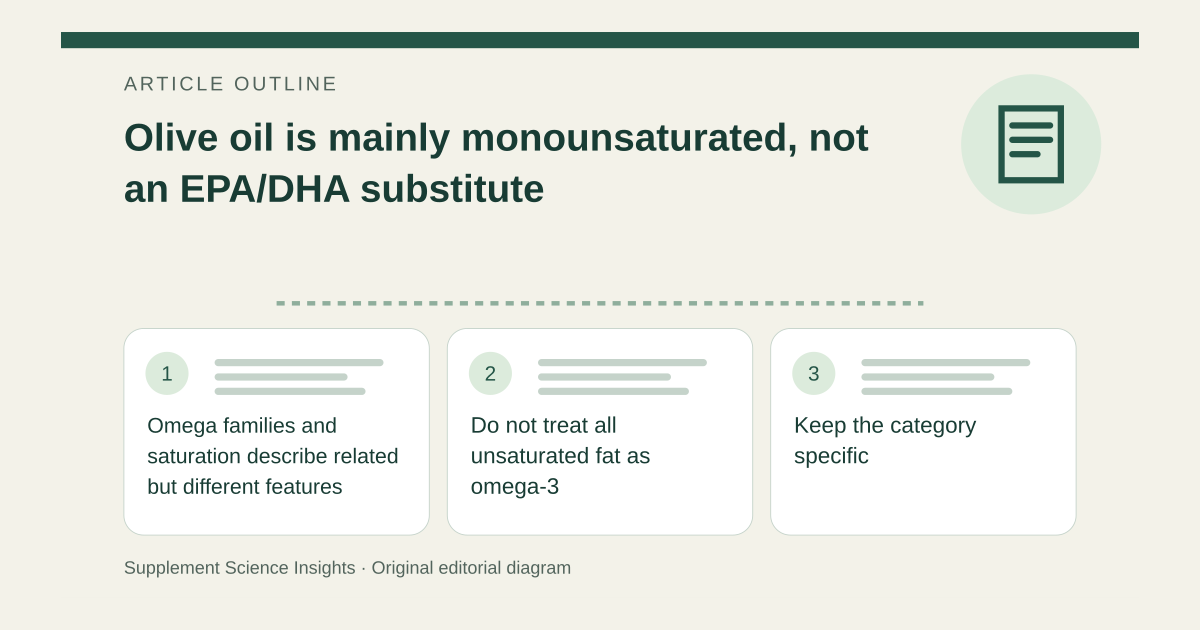
Omega families and saturation describe related but different features
The IUPAC lipid lexicon identifies oleic acid as an 18-carbon omega-9 fatty acid with one double bond. Harvard’s food-fat table lists olive oil as predominantly monounsaturated, with smaller saturated and polyunsaturated fractions. [1][2]
A mixed oil is not composed of only one fatty acid. The word monounsaturated describes the dominant type here, while the omega number identifies the position of a double bond from the methyl end. [1][2]
Do not treat all unsaturated fat as omega-3
Polyunsaturated fat can include different omega families, so its total amount is not an EPA/DHA amount. NIH ODS identifies specific foods as sources of ALA or the long-chain omega-3s EPA and DHA. [3][1]
Olive oil can be compared as a cooking fat without pretending it is compositionally equivalent to fish or an algal EPA/DHA preparation. The appropriate substitution depends on which dietary contribution is being compared. [3][1]
Keep the category specific
Imagine an oil lists mostly monounsaturated fat. Recording all of that amount as omega-3 would confuse the fat category with a particular fatty-acid family.
| Detail | Interpretation |
|---|---|
| Oleic acid | Monounsaturated omega-9 |
| Total polyunsaturated fat | Not all EPA/DHA |
| Omega-3 contribution | Needs a specific composition value |
Sources for this article
- Types of Fat • The Nutrition Source
Source consulted: 2026-09-19. This is a reference resource, not a claim that we conducted the studies or tested a product. - 7304x0685
Source consulted: 2026-09-19. This is a reference resource, not a claim that we conducted the studies or tested a product. - Omega-3 Fatty Acids - Health Professional Fact Sheet
Source consulted: 2026-09-19. This is a reference resource, not a claim that we conducted the studies or tested a product.