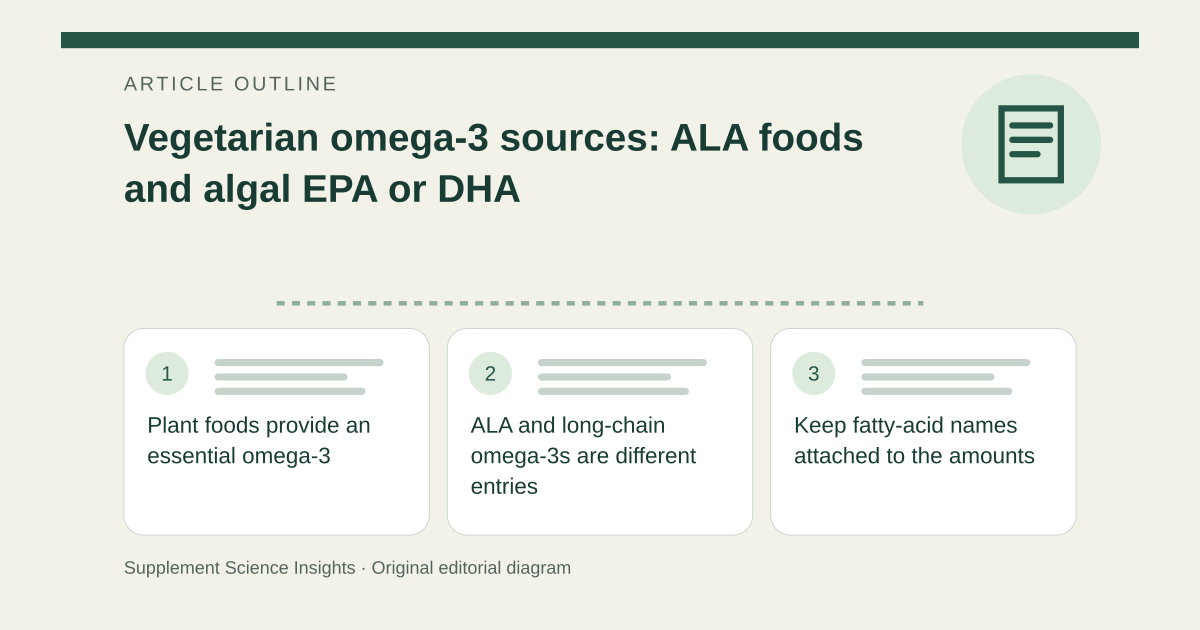
Plant foods provide an essential omega-3
Flaxseed, chia, walnuts and oils such as canola or soybean oil provide ALA. ODS lists these as useful dietary sources; walnuts should not be counted as though their ALA amount were a direct DHA dose. [1]
The U.S. adequate-intake references for adults concern ALA: 1.6 grams daily for men and 1.1 grams for women outside pregnancy and lactation. These are total-intake reference values, not required supplemental amounts. [1]
ALA and long-chain omega-3s are different entries
The body can convert ALA to EPA and then DHA, but ODS describes this conversion as limited. A gram of flaxseed oil or its ALA is therefore not equivalent to a gram of EPA or DHA. [1]
Microalgae originally produce the EPA and DHA that accumulate through the marine food chain. Algal-oil supplements can provide DHA directly, and some also contain EPA; the actual label is needed to identify which are supplied. [1]
Keep fatty-acid names attached to the amounts
Imagine a food record lists two grams of ALA from plant foods and a supplement lists 200 milligrams of DHA. Recording both is useful; relabeling the ALA as two grams of DHA is not.
This distinction allows a specific EPA/DHA question to be assessed without dismissing the nutritional value of ALA foods.
| Detail | Interpretation |
|---|---|
| Walnuts or flaxseed | Commonly counted for ALA |
| An algal-oil label | Check declared DHA and EPA |
| Equal total oil mass | Not equal fatty-acid exposure |
Diet type alone does not set a supplement regimen
ODS has no universal U.S. intake recommendation for EPA and DHA analogous to the ALA adequate intake. Particular life stages and medical goals need their own context. [1]
This page does not conclude that every vegetarian needs algal oil or verify that every capsule fits a vegan diet. Ingredient sourcing and capsule components remain product-specific questions. [1]
Sources for this article
- NIH ODS: Omega-3 Fatty Acids
Source consulted: 2026-09-17. This is a reference resource, not a claim that we conducted the studies or tested a product.