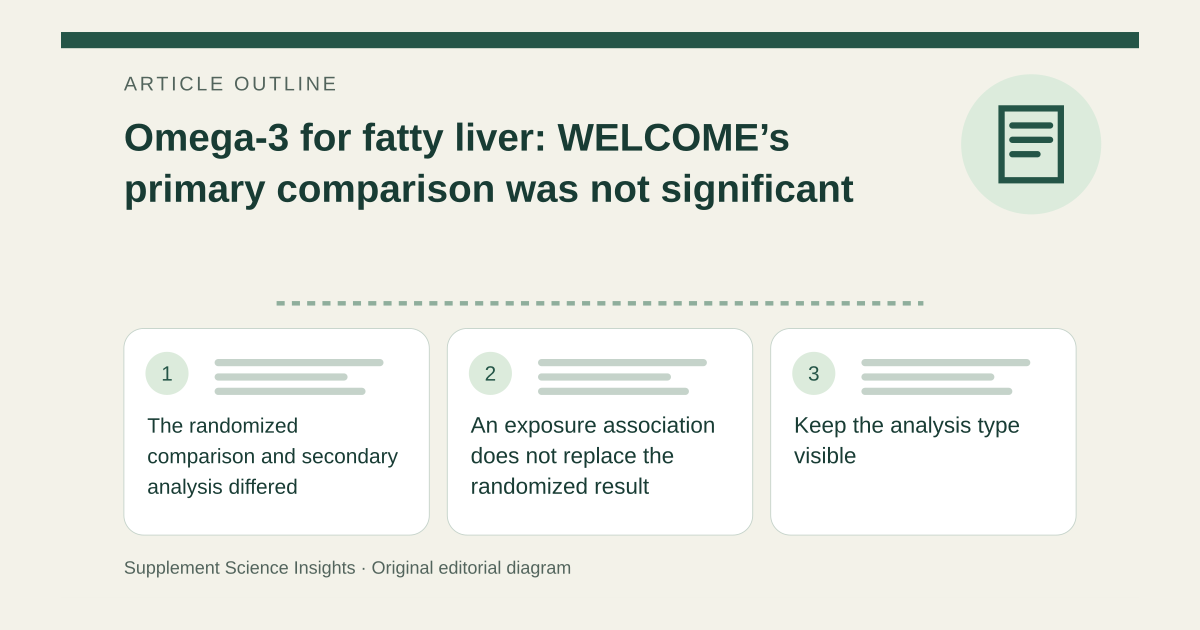
The randomized comparison and secondary analysis differed
The double-blind study assigned 103 people with fatty liver disease to a specified EPA/DHA preparation or placebo for 15–18 months. Liver fat was measured by magnetic resonance spectroscopy; fibrosis was assessed with validated biomarker scores. [1]
The adjusted treatment comparison showed a nonsignificant trend toward lower liver fat. A secondary analysis linked greater red-cell DHA enrichment with lower liver fat, but no improvement occurred in fibrosis scores. [1]
An exposure association does not replace the randomized result
Adherence varied, and some placebo participants had evidence of omega-3 exposure. These complications help explain uncertainty but do not turn the primary comparison into a positive result. [1]
Funding and conflicts were not established from the abstract. The study does not prove prevention of cirrhosis or establish equivalence of ordinary retail fish oil. Its older introductory statement about available treatments should not be used as a current description of liver-disease care. [1]
Keep the analysis type visible
Imagine people with higher measured nutrient levels improve more, while randomized treatment groups do not differ significantly. The association cannot silently replace the randomized comparison.
| Detail | Interpretation |
|---|---|
| Randomized liver-fat comparison | Not significant |
| DHA-enrichment association | Favorable secondary finding |
| Fibrosis scores | No improvement |
Sources for this article
- Effects of purified eicosapentaenoic and docosahexaenoic acids in nonalcoholic fatty liver disease: results from the Welcome* study - PubMed
Source consulted: 2026-09-19. This is a reference resource, not a claim that we conducted the studies or tested a product.