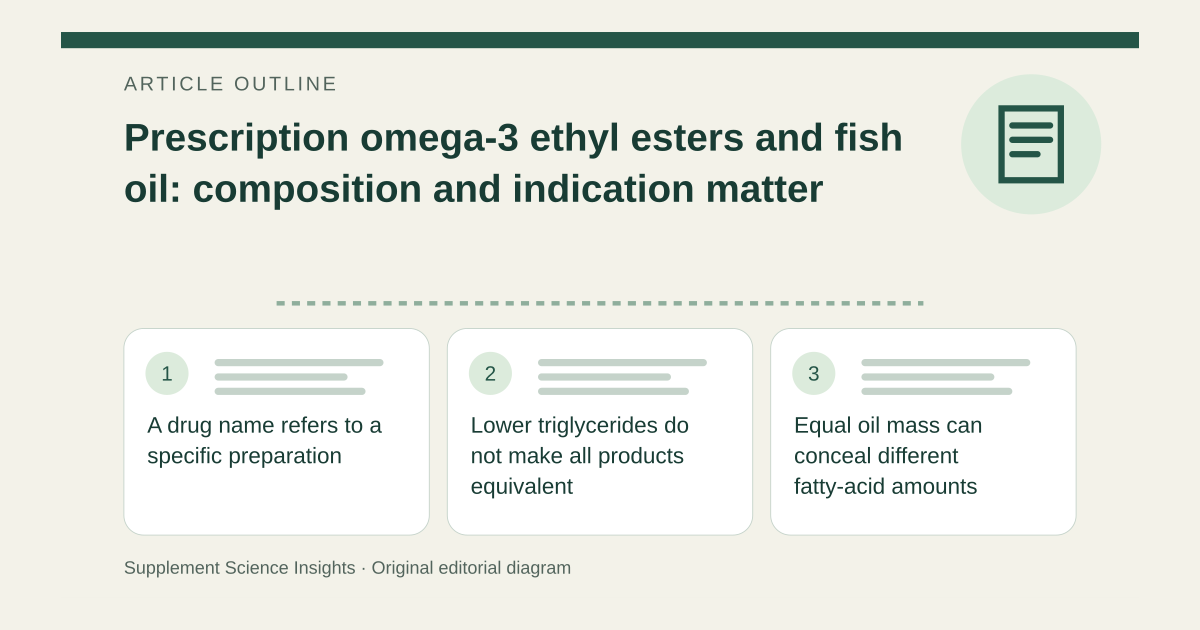
A drug name refers to a specific preparation
MedlinePlus describes prescription omega-3 treatment alongside lifestyle measures for very high triglycerides. Different medicines can contain different fatty-acid compositions, so the words omega-3 do not identify one uniform intervention. [1]
Follow the actual prescription and pharmacist’s instructions. The mass of total oil on a retail label cannot establish equivalence to a prescribed EPA/DHA dose or a purified EPA formulation. [1]
Lower triglycerides do not make all products equivalent
The 2026 multisociety dyslipidemia guideline distinguishes cardiovascular-outcome evidence for icosapent ethyl in defined high-risk patients from a general triglyceride-lowering effect. That evidence cannot be transferred to every fish-oil supplement or every prescription mixture. [2]
A change from prescribed treatment to a retail product therefore requires more than matching capsule count. The formulation, clinical indication and evidence for the intended outcome must match. [2]
Equal oil mass can conceal different fatty-acid amounts
Imagine a retail capsule lists 1 g total fish oil while the prescription specifies an active fatty-acid regimen. One capsule for another is not an established conversion. Ask the prescriber before making a substitution.
| Detail | Interpretation |
|---|---|
| Total fish oil | Not identical to EPA/DHA mass |
| Prescription formula | Defined intervention |
| Event reduction | Product- and population-specific |
Sources for this article
- MedlinePlus: Omega-3 Fatty Acids
Source consulted: 2026-09-17. This is a reference resource, not a claim that we conducted the studies or tested a product. - 2026 ACC/AHA/AACVPR/ABC/ACPM/ADA/AGS/APhA/ASPC/NLA/PCNA Guideline on the Management of Dyslipidemia: A Report of the American College of Cardiology/American Heart Association Joint Committee on Clinical Practice Guidelines | Circulation
Source consulted: 2026-09-17. This is a reference resource, not a claim that we conducted the studies or tested a product.