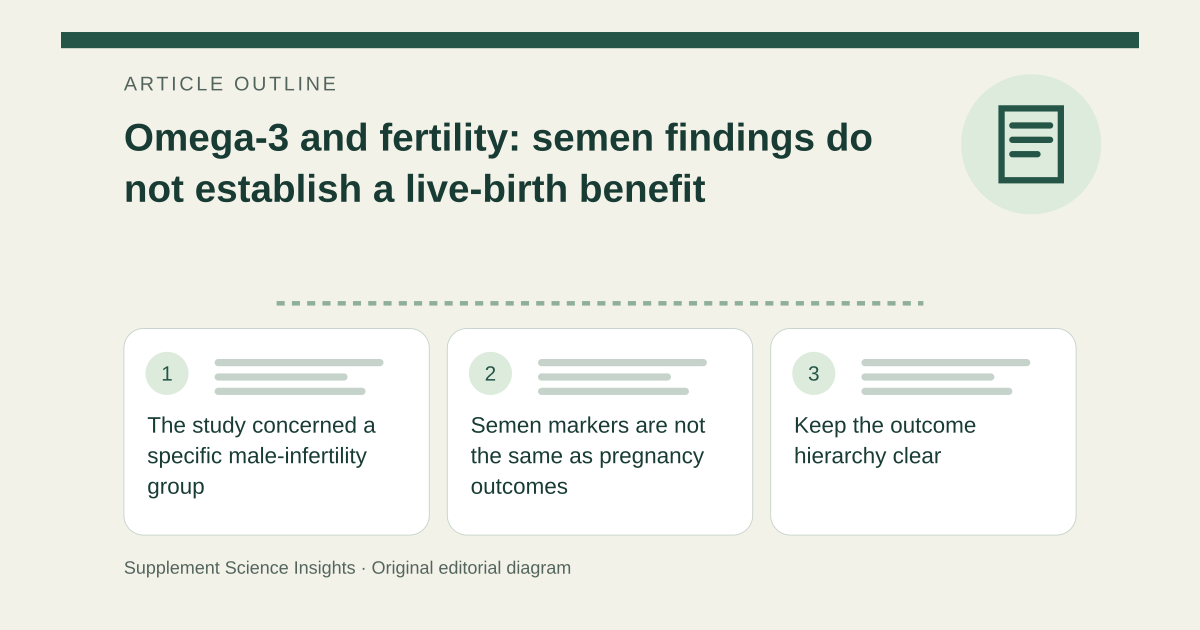
The study concerned a specific male-infertility group
The placebo-controlled trial randomized 238 men with idiopathic oligoasthenoteratospermia, a combination of low count, poor movement and abnormal sperm morphology. Two hundred eleven completed 32 weeks. [1]
The abstract reported improved sperm count and concentration in the omega-3 group, alongside correlations between fatty-acid levels, semen measures and antioxidant-enzyme activity. It did not provide every between-group effect estimate needed for a complete appraisal. [1]
Semen markers are not the same as pregnancy outcomes
The report does not establish a live-birth benefit, effects on female egg quality or the same response in men with another cause of infertility. A biomarker correlation also cannot identify which biological mechanism caused a change. [1]
Funding and conflicts were not established from the abstract. The investigators called for further study. These findings do not justify replacing fertility evaluation or assuming that a retail fish-oil product will correct an individual’s reproductive difficulty. [1]
Keep the outcome hierarchy clear
Imagine a semen measurement improves but pregnancies and births are not tracked. The study has not established that more couples ultimately have a baby.
| Detail | Interpretation |
|---|---|
| Defined abnormal semen profile | Selected male population |
| Semen markers | Reported outcomes |
| Live births and egg quality | Not established |
Sources for this article
- Effect of omega-3 polyunsaturated fatty acid supplementation on semen profile and enzymatic anti-oxidant capacity of seminal plasma in infertile men with idiopathic oligoasthenoteratospermia: a double-blind, placebo-controlled, randomised study - PubMed
Source consulted: 2026-09-19. This is a reference resource, not a claim that we conducted the studies or tested a product.