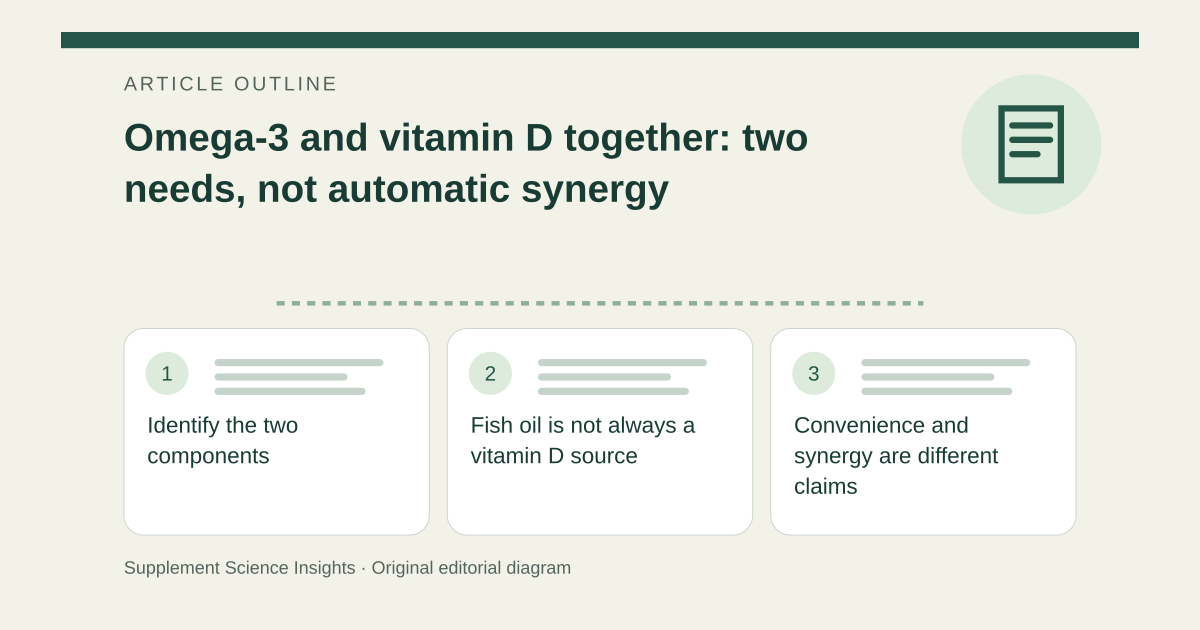
Identify the two components
EPA and DHA are fatty acids; vitamin D is a vitamin involved in calcium regulation and bone health, among other functions. A low intake of one does not automatically establish a deficiency of the other. NIH’s separate nutrient summaries do not justify treating the combination as a universal health prescription. [1][2]
Fish oil is not always a vitamin D source
Ordinary fish-oil products and cod liver oils differ. Cod liver oil can supply vitamins A and D as well as omega-3s. Read the vitamin D amount on the actual product and count other multivitamins or D supplements rather than assuming every oil contains the same vitamins. [1][2]
Convenience and synergy are different claims
Taking two nutrients in one serving can simplify a routine. To establish synergy, evidence would need to show a relevant combined advantage rather than merely describe two separate biological roles. The sources cited here do not establish that everyone benefits more from pairing them than from meeting their individual needs. [1][2]
The risks also remain ingredient-specific
Excess vitamin D can cause hypercalcemia. High-dose omega-3 treatment has its own rhythm, bleeding-medication and gastrointestinal considerations. Putting both in one capsule does not remove either set of limits. Check the full daily intake and review medically directed doses with the treating clinician. [2][1]
Count what is already present
Imagine someone adds a combined oil-and-D product to an existing vitamin D prescription. The useful first step is to total the vitamin D and EPA/DHA actually supplied, not assume the combination must be beneficial because both nutrients are essential to health. [2][1]
| Ingredient | Check separately |
|---|---|
| Vitamin D | Total intake across all products |
| EPA plus DHA | Actual amount and intended purpose |
| Combination claim | Evidence beyond separate nutrient roles |
Sources for this article
- Omega-3 Fatty Acids - Health Professional Fact Sheet
Source consulted: 2026-09-21. This is a reference resource, not a claim that we conducted the studies or tested a product. - Vitamin D - Health Professional Fact Sheet
Source consulted: 2026-09-21. This is a reference resource, not a claim that we conducted the studies or tested a product.