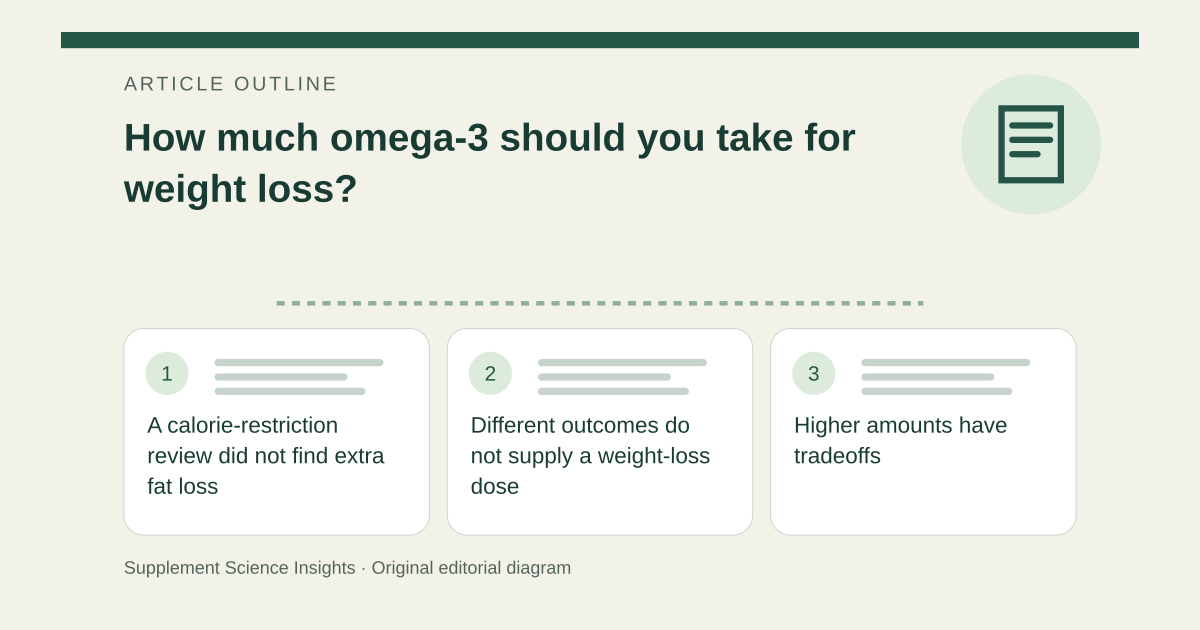
A calorie-restriction review did not find extra fat loss
A 2025 review included 11 studies with 637 adults with overweight or obesity. Omega-3 supplementation during calorie restriction did not significantly improve fat-mass loss or preserve fat-free mass compared with controls. The review also noted the limited number of studies. [1]
Different outcomes do not supply a weight-loss dose
Changes in blood lipids, a fatty-acid index or inflammatory markers are not equivalent to sustained weight loss. A preparation prescribed for triglycerides has a different purpose from a retail supplement promoted for slimming. [2]
Higher amounts have tradeoffs
ODS describes digestive adverse effects, medication considerations and atrial-fibrillation signals in some high-dose cardiovascular trials. A safety assessment is not a recommendation to take the maximum amount, especially for an unproven goal. [2]
Separate nutritional adequacy from weight management
Imagine someone adds fish oil while changing meals and activity. A lower scale reading cannot isolate the capsule’s effect. Choose an appropriate weight-management plan and assess any omega-3 use for its own defined purpose. [1][3]
| Question | Evidence boundary |
|---|---|
| Omega-3 nutrient role | Not a fat-burning prescription |
| Triglyceride change | Not body-fat loss |
| Larger dose | Can add risk |
| Multiple lifestyle changes | Cannot isolate the supplement |
Sources for this article
- Effects of Long-Chain n-3 Fatty Acids Supplementation During Caloric Restriction on Body Composition in Overweight and Obese Adults: A Systematic Review and Meta-Analysis of Randomized Controlled Trials.
Source consulted: 2026-09-21. This is a reference resource, not a claim that we conducted the studies or tested a product. - Omega-3 Fatty Acids - Health Professional Fact Sheet
Source consulted: 2026-09-21. This is a reference resource, not a claim that we conducted the studies or tested a product. - Dietary Supplements: What You Need to Know
Source consulted: 2026-09-21. This is a reference resource, not a claim that we conducted the studies or tested a product.