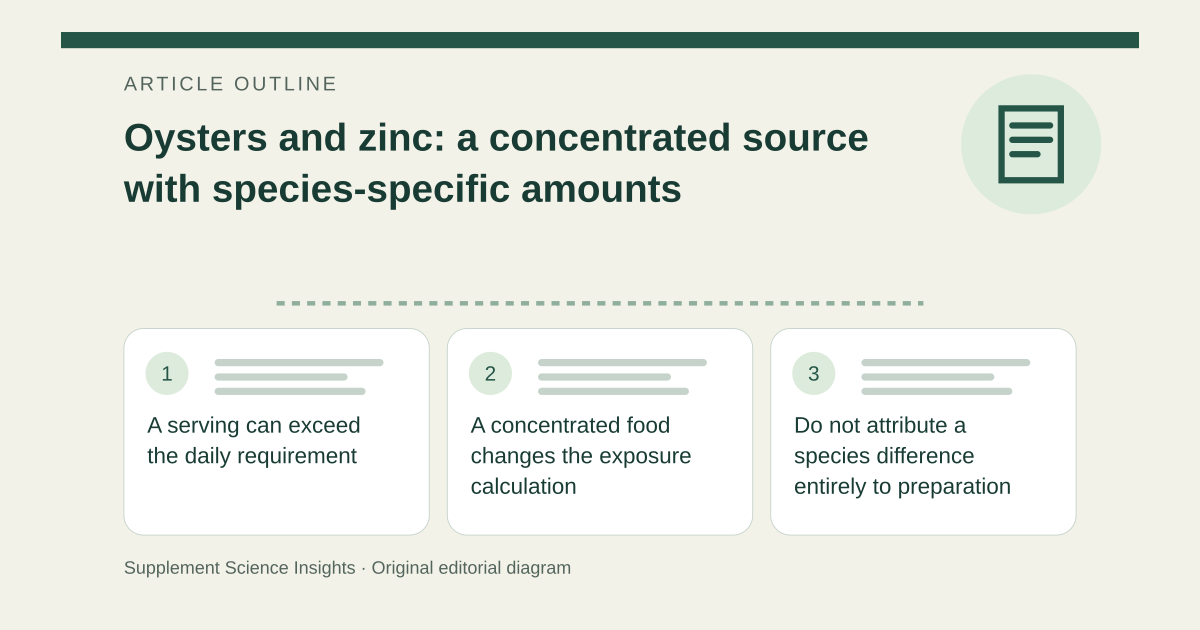
A serving can exceed the daily requirement
ODS lists 32 mg zinc in three ounces of raw farmed Eastern oysters and 28.2 mg in three ounces of cooked Pacific oysters. These are different species and preparations, so the table does not isolate the effect of cooking. [1]
Both entries are concentrated compared with adult RDAs of 11 mg for men and 8 mg for women outside pregnancy and lactation. Exceeding an RDA in a food serving is not itself a diagnosis of toxicity; the requirement and the safety limit have different meanings. [1]
A concentrated food changes the exposure calculation
The adult zinc upper limit is 40 mg daily from food and supplements. An oyster meal can therefore materially change a daily total when a zinc-containing supplement is also used. The limit is not a precise acute-poisoning threshold. [1][2]
Oysters also provide other nutrients, but high zinc content does not establish a treatment for low testosterone, infertility or immune problems. This food-composition comparison makes no clinical benefit claim and does not rank oyster products. [1][2]
Do not attribute a species difference entirely to preparation
Imagine a table compares raw Eastern oysters with cooked Pacific oysters. The two entries differ in more than cooking status. A conclusion that cooking alone caused the difference would require a matched comparison not supplied by those rows.
| Entry | Meaning |
|---|---|
| Eastern versus Pacific | Different species |
| Raw versus cooked | Different preparation |
| Cause of the numerical difference | Not isolated by the table |
Sources for this article
- NIH ODS: Zinc
Source consulted: 2026-09-17. This is a reference resource, not a claim that we conducted the studies or tested a product. - NIH ODS: Vitamin B12
Source consulted: 2026-09-17. This is a reference resource, not a claim that we conducted the studies or tested a product.