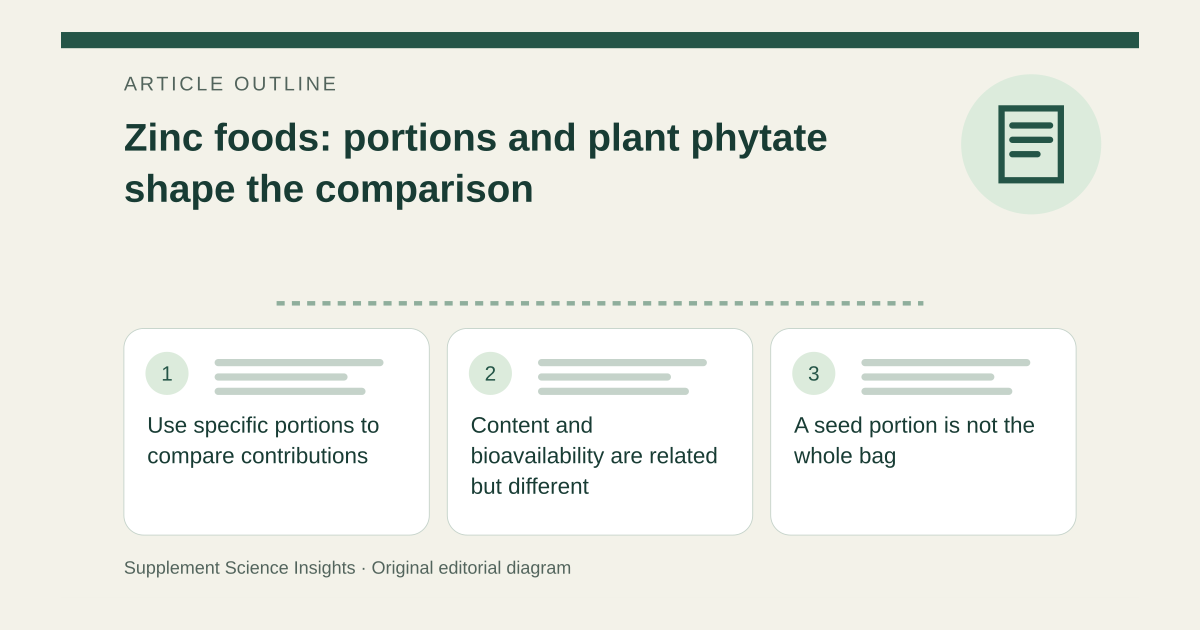
Use specific portions to compare contributions
The ODS table lists 3.8 mg zinc in three ounces of roasted bottom-sirloin beef, 2.2 mg in an ounce of roasted pumpkin seeds and 1.3 mg in half a cup of boiled lentils. These examples describe food contributions rather than supplement equivalence. [1]
Fortified cereals can add zinc, but the amount depends on the actual product. Fruit and vegetables generally contain relatively little zinc, so a varied diet should not be reduced to a single fruit marketed as a mineral source. [1]
Content and bioavailability are related but different
Phytates in beans, nuts and whole grains can bind zinc and reduce its absorption. This is a reason to consider the complete dietary pattern, not to mark the zinc in these foods as zero or assume all plant-based diets are deficient. [1]
ODS describes a broad range of absorption across diets. A fixed percentage applied to every meal would invent more precision than the food table supplies. Dietary amount, absorbed amount and laboratory status should remain separate entries. [1]
A seed portion is not the whole bag
Imagine a bag contains four one-ounce servings of pumpkin seeds. The table’s one-ounce zinc entry describes one serving; consuming the entire bag would represent four such portions in an estimate. The arithmetic does not establish the exact bag composition or a recommended amount to eat.
| Entry | Meaning |
|---|---|
| One ounce of seeds | Table serving |
| Four servings | Four times the estimated contribution |
| Actual absorption | Not determined by that multiplication |
Sources for this article
- NIH ODS: Zinc
Source consulted: 2026-09-17. This is a reference resource, not a claim that we conducted the studies or tested a product.