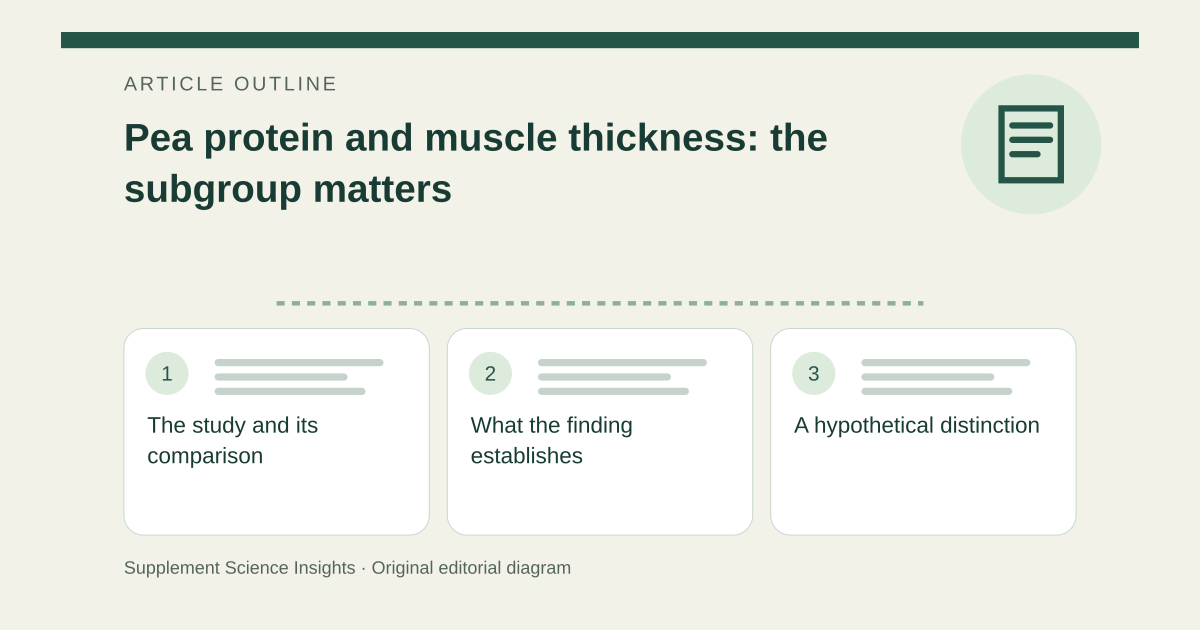
The study and its comparison
A 12-week study randomized 161 young men to pea protein, whey protein or placebo alongside upper-body resistance training. Protein groups received 25 grams twice daily. [1]
The overall between-group comparison for muscle thickness had a P value of 0.09. A subgroup with lower baseline strength showed greater thickness gain with pea than placebo; strength gains did not differ across groups. [1]
What the finding establishes
The subgroup result should not be presented as the overall trial result or proof that pea outperforms whey. Roquette funded the study and employed three authors. Company-affiliated authors participated in study design and manuscript work, which warrants attention when appraising the findings. [1]
A hypothetical distinction
Imagine a result is significant only after selecting the weakest participants. The headline should retain that restriction.
| Detail | Interpretation |
|---|---|
| Measured outcome | Keep the endpoint specific |
| Study preparation | Not every retail product |
| Remaining uncertainty | Not resolved by a mechanism |
Sources for this article
- Pea proteins oral supplementation promotes muscle thickness gains during resistance training: a double-blind, randomized, Placebo-controlled clinical trial vs. Whey protein - PMC
Source consulted: 2026-09-19. This is a reference resource, not a claim that we conducted the studies or tested a product.