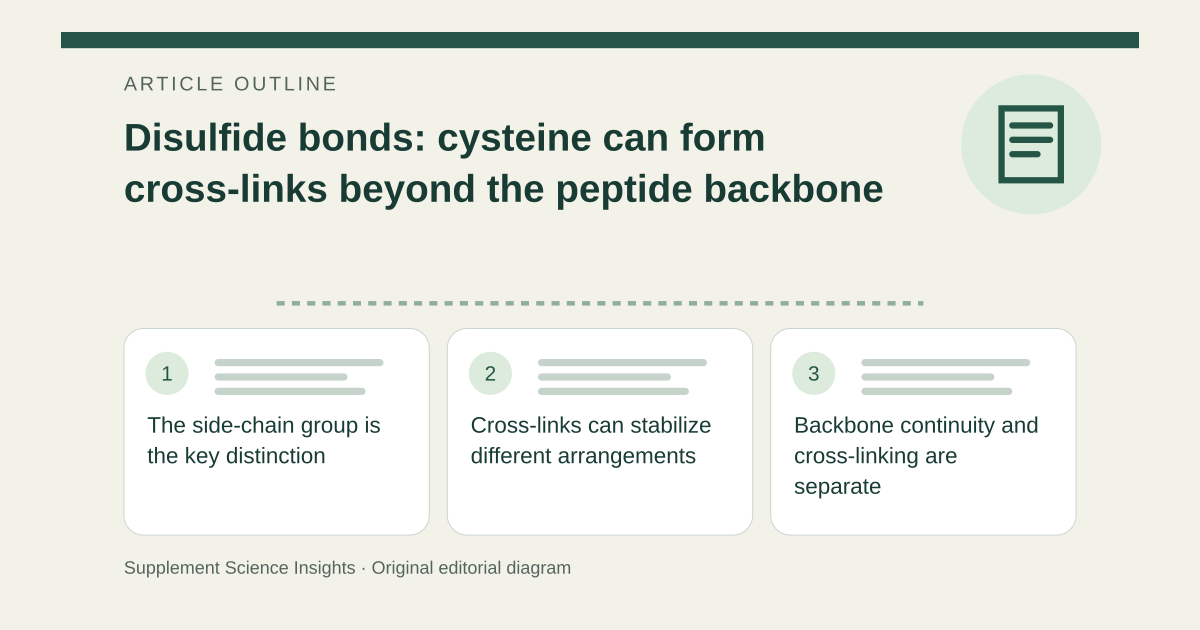
The side-chain group is the key distinction
Cysteine has a thiol group in its side chain. Two such groups can form a disulfide linkage, joining their sulfur atoms. This provides a covalent connection in addition to the peptide backbone. The bonded cysteine pair is often described as cystine. [1][2]
Methionine also contains sulfur, but its sulfur sits in a different chemical group. The presence of sulfur alone is therefore not enough to classify an amino acid as forming the same kind of disulfide linkage. [1][2]
Cross-links can stabilize different arrangements
A disulfide can connect two positions within one polypeptide or link separate polypeptide chains. The source’s insulin example illustrates both kinds of connection. The locations of the bonds matter to the resulting arrangement, not only their number. [1][2]
A protein can contain cysteine without every cysteine forming a disulfide. Chemical environment and structural context matter. These facts describe protein organization and do not establish that taking more cysteine strengthens every tissue or improves a clinical outcome. [1][2]
Backbone continuity and cross-linking are separate
Imagine two segments of one chain are joined by a side-chain cross-link. Removing that cross-link is not necessarily the same as cutting the peptide backbone. The chain’s connectivity and its stabilized shape are related but distinct features.
| Feature | Interpretation |
|---|---|
| Peptide bond | Joins consecutive backbone units |
| Disulfide bond | Joins cysteine side chains |
| Sulfur in methionine | Different chemical group |
Sources for this article
- OpenStax Biology 2e: Proteins
Source consulted: 2026-09-17. This is a reference resource, not a claim that we conducted the studies or tested a product. - OpenStax Organic Chemistry: Structures of Amino Acids
Source consulted: 2026-09-17. This is a reference resource, not a claim that we conducted the studies or tested a product.