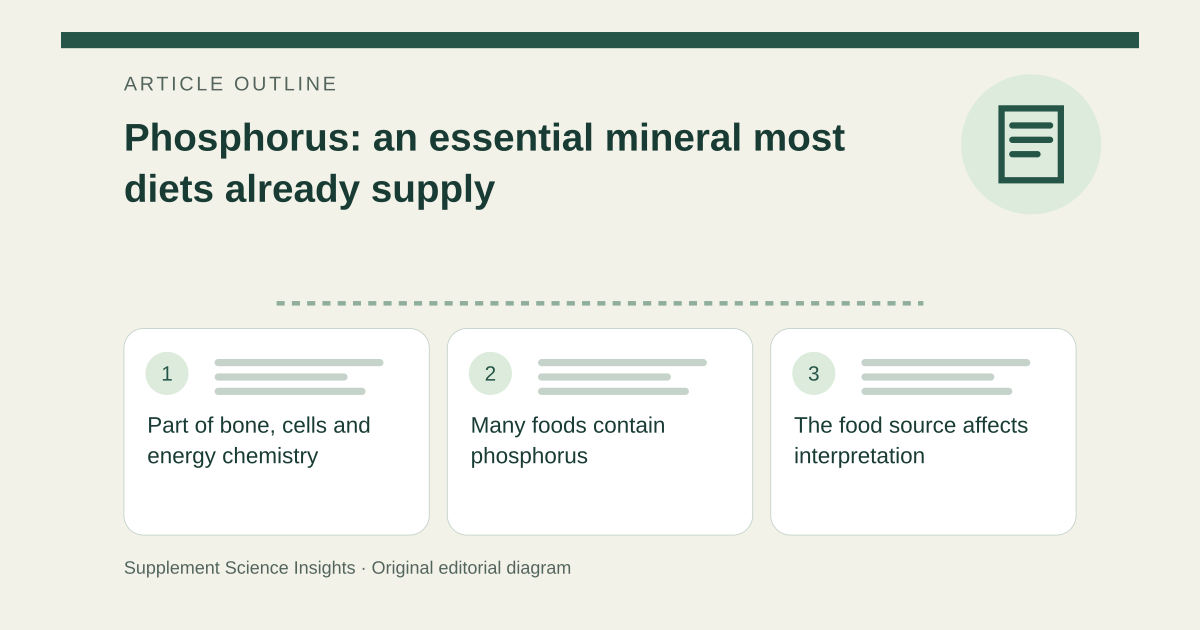
Part of bone, cells and energy chemistry
Phosphorus is part of bones and teeth, genetic material and cell membranes. Phosphate also participates in ATP, a molecule involved in transferring energy within cells. These functions explain why phosphorus is necessary; they do not show that adding phosphate improves energy in a person with adequate intake. [1]
Calcium, vitamin D and phosphorus metabolism are connected. That connection is not a reason to choose a supplement by a simple marketing ratio. Whole-body regulation and existing intake matter more than whether two numbers look balanced on the package. [1]
Many foods contain phosphorus
Dairy foods, meat, poultry, fish, eggs, nuts, beans and grains provide phosphorus. The U.S. recommended dietary allowance for adults is 700 mg per day. Most people consume enough, and deficiency from low food intake alone is uncommon. [2]
Phosphate additives provide another source. Ingredient lists may identify compounds containing “phos,” but an ingredient list generally does not tell you the exact phosphorus contribution of each additive. An absent number is missing information rather than evidence of zero exposure. [2]
The food source affects interpretation
Phosphorus in plant foods is often bound in phytate and is less readily absorbed than some other forms. Additives and animal foods therefore cannot be assumed to contribute identically to absorbed phosphorus merely because their total amounts match. [1]
This is especially relevant when a renal dietitian discusses food choices. It does not justify discarding plant foods or attempting your own absorption correction from a generic percentage. Preparation, portions and the complete clinical plan still matter. [1]
A kidney-care issue can reverse the usual goal
When kidney function declines, the body may have difficulty excreting phosphate. Elevated phosphorus can become part of a wider mineral-and-bone disorder. Someone being treated for kidney disease should discuss phosphate supplements and relevant food additives with the renal team. [2][1]
Some medicines, including certain antacids, can affect phosphorus balance. A low blood result has several possible explanations and is not a diagnosis that can be made from fatigue or weakness. Treatment amounts and monitoring belong to the clinician managing the underlying problem. [2][1]
Count the nutrient rather than the salt
Consider a fictional tablet that states “phosphorus 100 mg, as calcium phosphate.” A separate front-panel statement gives the tablet's total mineral-complex weight as 500 mg. The phosphorus entry is 100 mg, not 500 mg.
If two such tablets are listed as the serving, first establish whether the 100 mg applies to one tablet or the two-tablet serving. Under the latter declaration, each tablet supplies 50 mg. The example teaches denominator reading; it does not suggest adding phosphorus to the diet.
| Statement | Interpretation |
|---|---|
| 100 mg per two-tablet serving | 50 mg per tablet |
| 500 mg mineral-complex weight | Not the phosphorus amount |
Choose a question that changes the decision
For a healthy person considering a general wellness product, the first question is why additional phosphorus is needed. For someone with kidney disease, the question may instead be how to manage existing exposure. Those are different decisions even when the nutrient name is identical.
Keep the actual nutrient panel and any recent clinical advice together. This overview covers dietary phosphorus and supplement interpretation, not a kidney-disease treatment protocol, a sports-performance recommendation or a ranking of phosphate salts.
Sources for this article
- NIH ODS — Phosphorus, professional fact sheet
Source consulted: 2026-09-17. This is a reference resource, not a claim that we conducted the studies or tested a product. - NIH ODS — Phosphorus, consumer fact sheet
Source consulted: 2026-09-17. This is a reference resource, not a claim that we conducted the studies or tested a product.