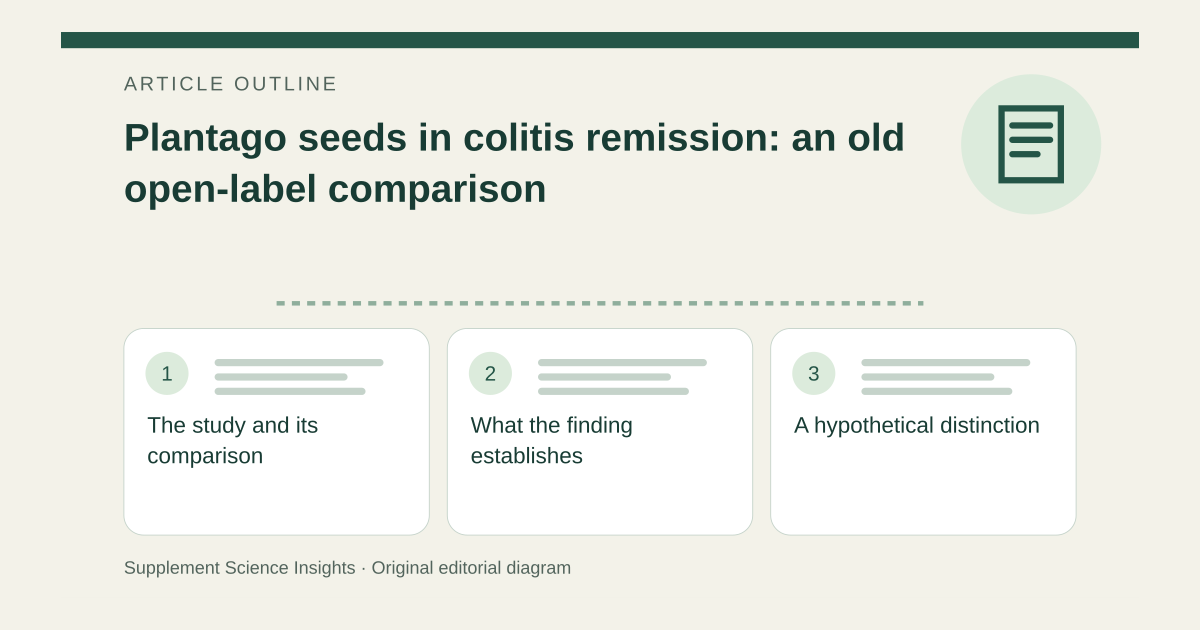
The study and its comparison
One hundred five patients with ulcerative colitis in remission were randomized to Plantago ovata seeds, mesalamine, or both for 12 months. The study was open label, and 102 participants were included in the final analysis. [1]
Reported treatment-failure proportions were 40, 35 and 30 percent respectively, without a significant remission difference. Some participants withdrew because of constipation or flatulence; fecal butyrate increased after seed treatment. [1]
What the finding establishes
A nonsignificant difference does not by itself prove interchangeability. This was remission maintenance, not treatment of an acute flare, and the seed preparation is not every husk product. Funding and conflicts were not established from the abstract. Do not replace prescribed colitis therapy on this basis. [1]
A hypothetical distinction
Imagine remission outcomes look similar in a modest trial. That is not automatically a formal demonstration of equal effectiveness.
| Detail | Interpretation |
|---|---|
| Measured outcome | Keep the endpoint specific |
| Study preparation | Not every retail product |
| Remaining uncertainty | Not resolved by a mechanism |
Sources for this article
- Randomized clinical trial of Plantago ovata seeds (dietary fiber) as compared with mesalamine in maintaining remission in ulcerative colitis. Spanish Group for the Study of Crohn's Disease and Ulcerative Colitis (GETECCU).
Source consulted: 2026-09-19. This is a reference resource, not a claim that we conducted the studies or tested a product.