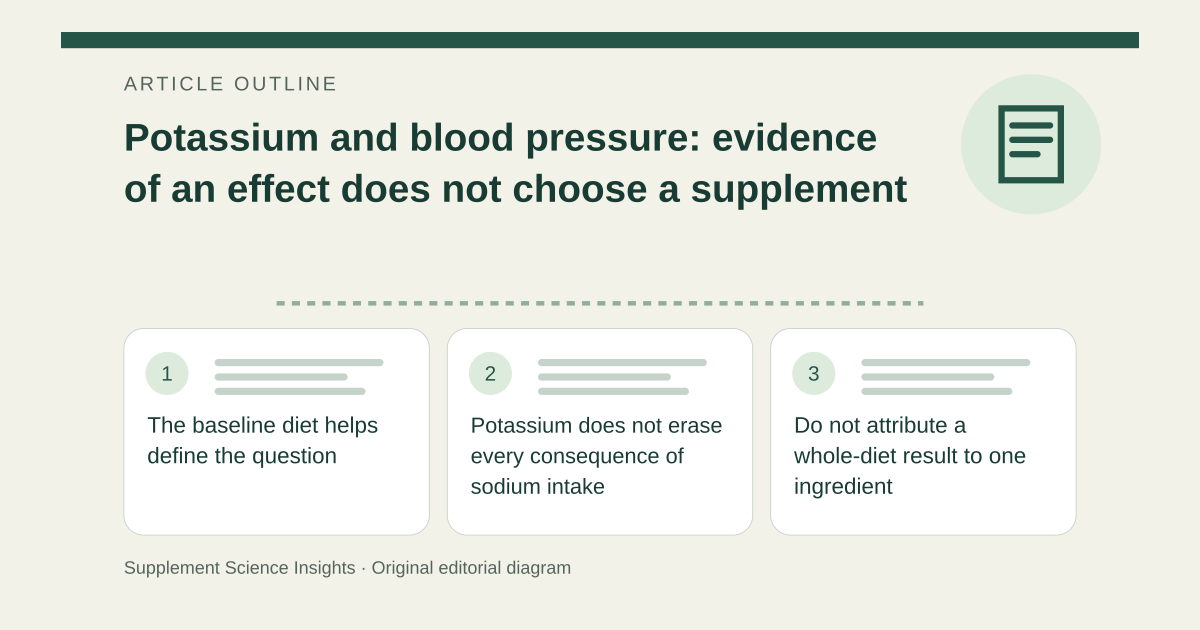
The baseline diet helps define the question
ODS summarizes trial evidence that potassium supplementation can reduce blood pressure, particularly in people with hypertension. Response depends on the studied intake and population, so an average trial effect is not a promised personal reduction. [1]
The DASH dietary pattern supplies potassium alongside other changes, including calcium, magnesium and food choices. Its observed blood-pressure effect cannot be assigned entirely to potassium or reproduced by assumption with a single supplement. [1]
Potassium does not erase every consequence of sodium intake
Potassium and sodium interact in fluid and blood-pressure regulation, but adding potassium is not a universal permission to consume unlimited salt. The relevant plan concerns the overall diet and prescribed treatment. [1]
Reduced kidney function, ACE inhibitors, angiotensin receptor blockers and potassium-sparing diuretics can increase hyperkalemia risk. A potassium-based salt substitute is therefore not automatically suitable for every person with hypertension. Review the exact medicines and product before using one. [1]
Do not attribute a whole-diet result to one ingredient
Imagine a person follows a diet intervention that changes several foods and minerals, then has lower blood pressure. The observation cannot isolate the potassium contribution. A comparison designed to test potassium separately would address that narrower causal question.
| Detail | Interpretation |
|---|---|
| DASH-style pattern | Several dietary changes |
| Blood pressure changes | Overall observed response |
| Potassium alone caused it | Not isolated by that pattern |
Sources for this article
- NIH ODS: Potassium
Source consulted: 2026-09-17. This is a reference resource, not a claim that we conducted the studies or tested a product.