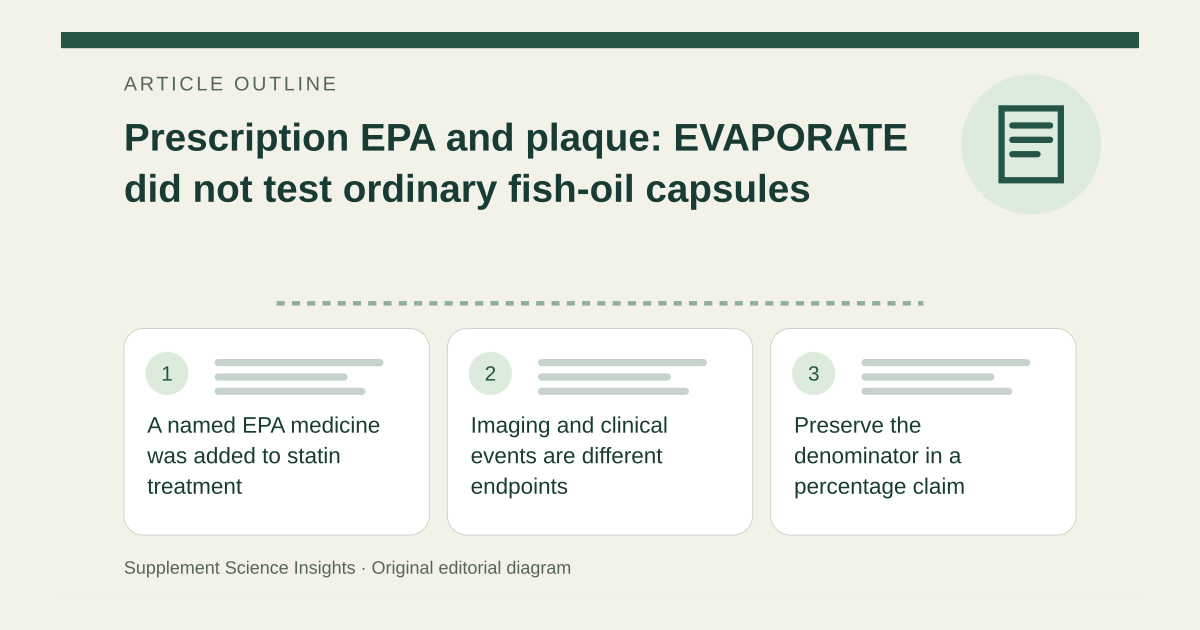
A named EPA medicine was added to statin treatment
The trial enrolled 80 patients with coronary atherosclerosis and persistently elevated triglycerides who were taking statins. They received icosapent ethyl, a purified EPA ethyl ester, or placebo for 18 months. [1]
The primary CT-derived low-attenuation plaque volume decreased by 17% in the active group and increased by 109% in the placebo group. Those percentages describe that plaque category, not the percentage of all arterial blockage removed. [1]
Imaging and clinical events are different endpoints
This trial investigated plaque characteristics rather than proving a reduction in heart attacks within its small sample. It also did not test an arbitrary over-the-counter EPA/DHA mixture. [1]
Funding and conflicts were not fully assessed from the abstract. The result should be interpreted alongside evidence for the specific medicine and the patient’s clinical indication. It does not support replacing statins or describing all fish oil as an artery-clearing treatment. [1]
Preserve the denominator in a percentage claim
Imagine one imaging-defined plaque component falls by 17%. That is not the same as saying an artery becomes 17% less blocked or every plaque component shrinks.
| Detail | Interpretation |
|---|---|
| Icosapent ethyl | Specific prescription preparation |
| Low-attenuation plaque volume | Primary imaging endpoint |
| Generic fish-oil capsules | Not tested |
Sources for this article
- Effect of icosapent ethyl on progression of coronary atherosclerosis in patients with elevated triglycerides on statin therapy: final results of the EVAPORATE trial - PubMed
Source consulted: 2026-09-19. This is a reference resource, not a claim that we conducted the studies or tested a product.