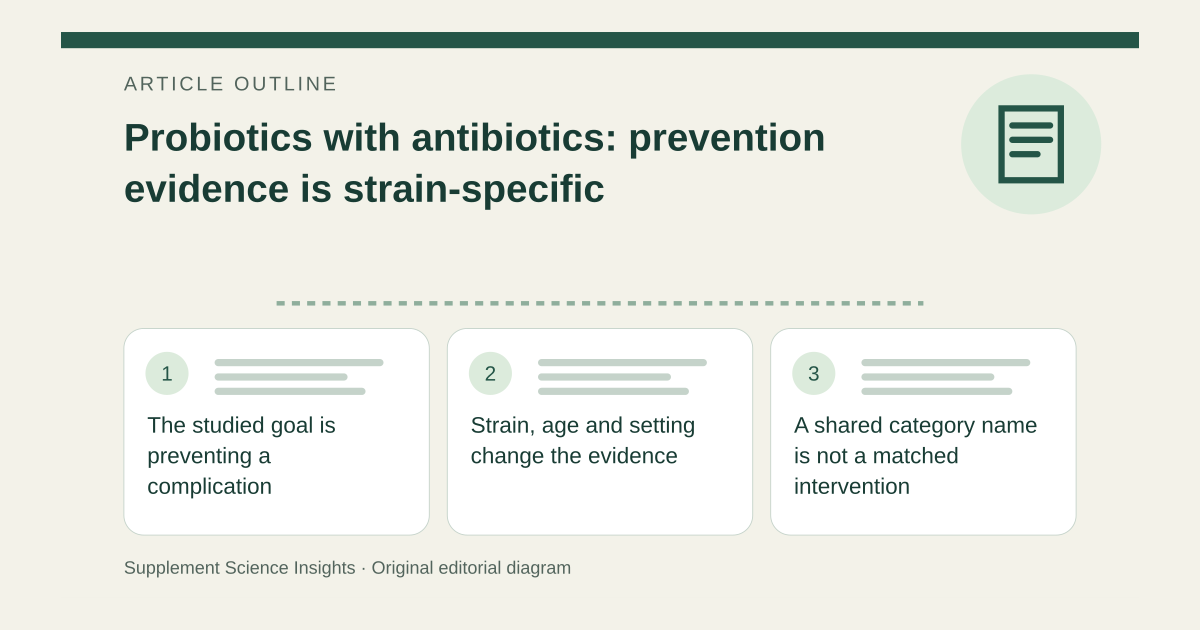
The studied goal is preventing a complication
Antibiotics can disrupt intestinal microbial activity and contribute to diarrhea. ODS describes evidence that certain probiotic preparations reduce the risk of antibiotic-associated diarrhea in selected patients. [1]
That question differs from whether a probiotic treats the infection for which the antibiotic was prescribed. A prevention result is not a reason to omit, shorten or replace prescribed antibiotic treatment. [1]
Strain, age and setting change the evidence
The ODS summary identifies Lactobacillus rhamnosus GG and Saccharomyces boulardii among studied preparations. Benefits depend on factors including age, antibiotic exposure and inpatient versus outpatient care. [1]
It reports that starting studied preparations early in the antibiotic course can matter. This does not define a universal hour-by-hour separation rule for every product or show that more strains are necessarily better. [1]
A shared category name is not a matched intervention
Imagine a study uses one identified strain while a retail blend lists a different combination. Both being called probiotics does not establish that the blend reproduces the trial’s effect.
Record the organism, strain, amount, population and timing before applying the finding. An unspecified blend leaves important parts of the comparison unresolved.
| Question | Interpretation |
|---|---|
| Exact strain studied | Check the product identity |
| Age and care setting | Preserve applicability |
| Treating the original infection | A different question |
Some patients have a different risk balance
ODS notes rare serious infections associated with probiotic use, especially in severe illness or immune compromise. Reassurance from otherwise healthy participants should not be generalized to those settings. [1]
Discuss suitability with the treating clinician. This summary does not independently reappraise the trials or select a product, and persistent diarrhea still requires assessment of its cause. [1]
Sources for this article
- NIH ODS: Probiotics
Source consulted: 2026-09-17. This is a reference resource, not a claim that we conducted the studies or tested a product.