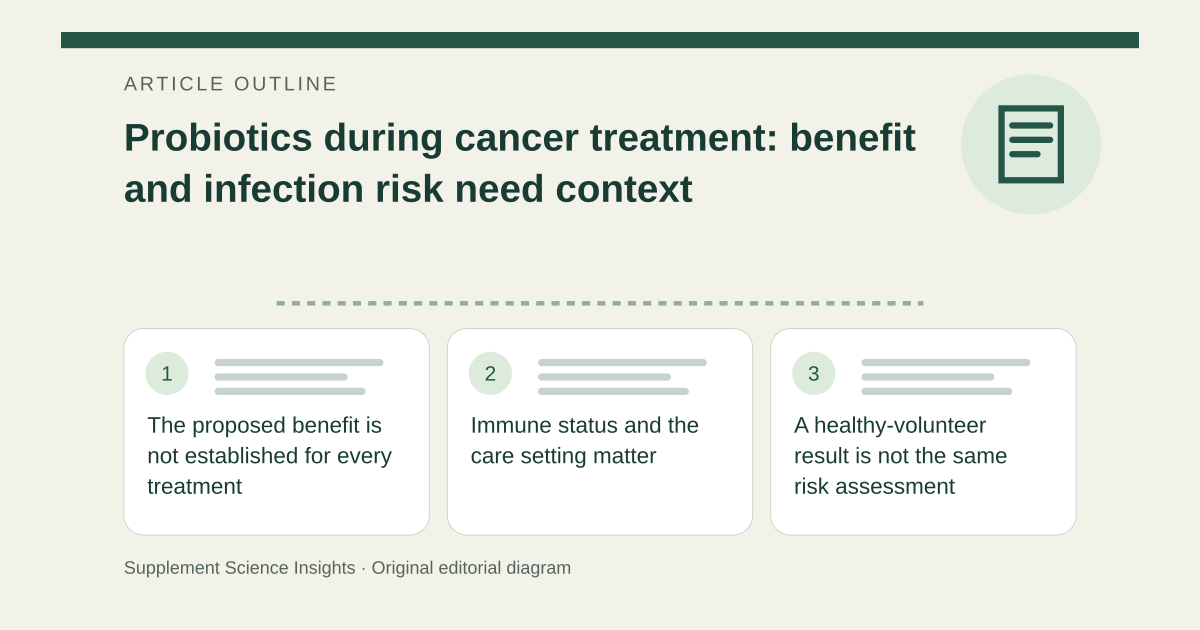
The proposed benefit is not established for every treatment
Chemotherapy or radiotherapy can cause diarrhea. NCCIH summarizes a 2018 review of twelve studies involving 1,554 participants that found inconclusive evidence that probiotics prevent or treat this complication. [1]
The result concerns treatment-related diarrhea, not cancer control or a general claim of improved recovery. Different cancer treatments and patient populations should not be treated as one interchangeable setting. [1]
Immune status and the care setting matter
ODS and NCCIH describe rare serious infections associated with probiotic organisms, with particular concern in people who are severely ill or immunocompromised. Some safety studies also provide incomplete information on harms. [2][1]
Not every person with cancer has the same immune status or treatment exposure. That variation is why neither blanket reassurance nor a single rule for all patients follows from the category name. [2][1]
A healthy-volunteer result is not the same risk assessment
Imagine a probiotic was tolerated in healthy adults, while a person considering it is receiving treatment that suppresses immune function. The trial population does not match that safety question.
The exact product and treatment context need review by the oncology team; the word probiotic cannot supply the missing evidence.
| Question | Interpretation |
|---|---|
| Treatment-related diarrhea benefit | Evidence is inconclusive |
| Immune compromise | May change infection risk |
| A specific supplement decision | Needs the oncology context |
Keep symptom assessment within the treatment plan
Do not use a probiotic to postpone reporting diarrhea or other symptoms during cancer therapy. The cause and the appropriate response may depend on the treatment regimen. [1][2]
This page summarizes the inspected agency sources and does not independently reappraise cancer trials, recommend a strain or modify an oncology plan. [1][2]
Sources for this article
- NCCIH: Probiotics—Usefulness and Safety
Source consulted: 2026-09-17. This is a reference resource, not a claim that we conducted the studies or tested a product. - NIH ODS: Probiotics
Source consulted: 2026-09-17. This is a reference resource, not a claim that we conducted the studies or tested a product.