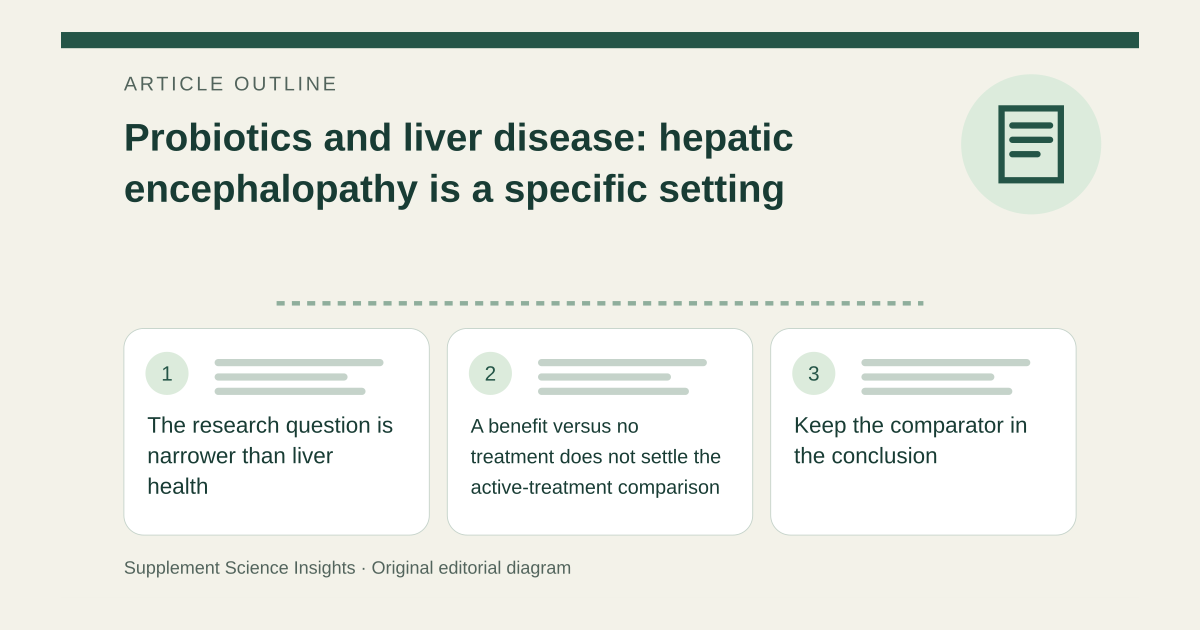
The research question is narrower than liver health
Hepatic encephalopathy can occur when liver dysfunction allows substances that affect the nervous system to accumulate. It is a complication of significant disease, not a synonym for needing a routine detox supplement. [1]
NCCIH describes probiotic research in this particular setting. Findings in those patients cannot automatically be transferred to healthy people, all liver conditions or a claim that any probiotic cleans the liver. [1]
A benefit versus no treatment does not settle the active-treatment comparison
The agency summarizes a 2017 review of twenty-one studies involving 1,420 participants, generally of low quality. Probiotics appeared beneficial compared with placebo or no treatment, but whether they were better than lactulose was uncertain. [1]
That comparator distinction is central. Evidence against an inactive control does not establish that replacing an established treatment improves outcomes. [1]
Keep the comparator in the conclusion
Imagine one study compares a probiotic with no additional intervention. A favorable result cannot be rewritten as proof that the probiotic outperforms an existing medicine.
A direct active-treatment comparison, with appropriate participants and outcomes, would be needed to answer that separate question.
| Question | Interpretation |
|---|---|
| Hepatic encephalopathy | A specific disease complication |
| Compared with placebo | Not compared with every standard therapy |
| General liver detox claim | Not established |
Serious disease changes both need and safety
NCCIH notes greater probiotic risks in severe illness or compromised immunity and advises close clinical monitoring for serious underlying conditions. General healthy-person reassurance is insufficient here. [1]
Do not use this article to replace liver care or assess new confusion. It summarizes older evidence rather than independently reappraising the trials or prescribing a preparation. [1]
Sources for this article
- NCCIH: Probiotics—Usefulness and Safety
Source consulted: 2026-09-17. This is a reference resource, not a claim that we conducted the studies or tested a product.