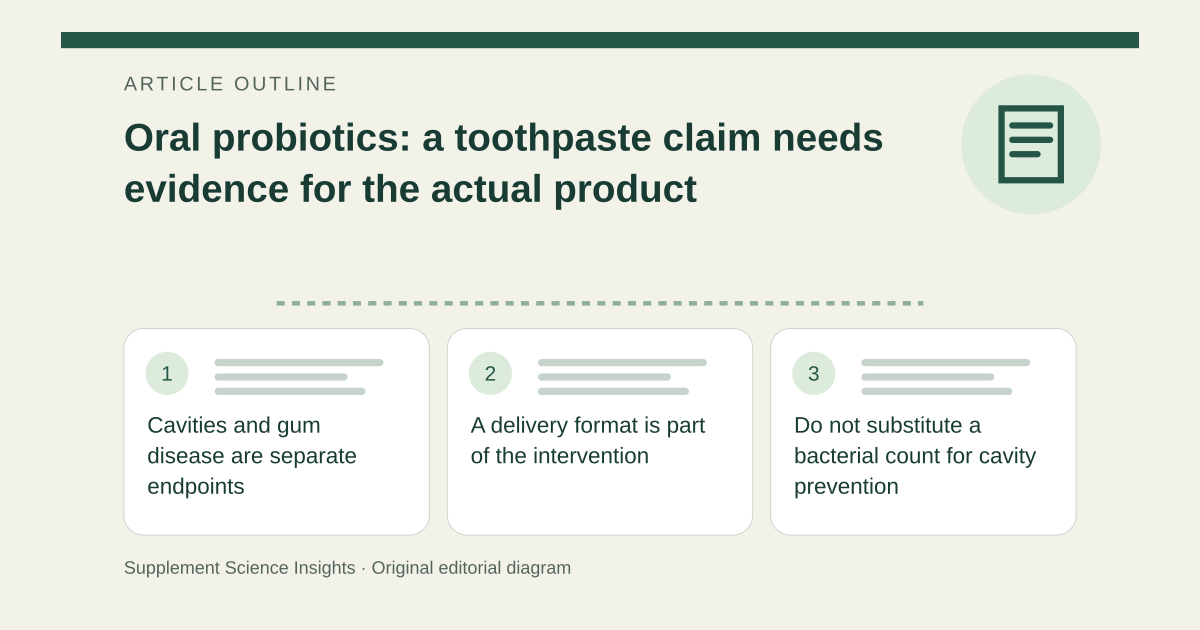
Cavities and gum disease are separate endpoints
NCCIH summarizes a small body of cavity-prevention research in infants and young children as low-quality evidence without a firm effectiveness conclusion. That does not establish cavity prevention in adults or in all delivery formats. [1]
For periodontal disease, the source describes an older review suggesting possible benefit as an addition to treatment, with effects differing between probiotics. An adjunctive role means the probiotic was considered alongside care, not as a replacement for it. [1]
A delivery format is part of the intervention
A toothpaste can differ from a lozenge, food or other preparation in strain, viable amount and exposure. A general oral-microbiome explanation cannot demonstrate that the particular toothpaste preserves viable organisms or improves a clinical outcome. [1]
Ask whether the actual preparation was studied and whether the endpoint was a bacterial measurement, a gum sign or new cavities. This article does not recommend replacing the dental plan or infer effectiveness from a product’s probiotic wording. [1]
Do not substitute a bacterial count for cavity prevention
Imagine an oral study records a change in selected bacterial counts but does not count new cavities. Its result may describe the measured microbes; it cannot establish that the product prevented decay. The clinical endpoint needs its own observation.
| Detail | Interpretation |
|---|---|
| Bacterial count | Microbiological endpoint |
| Gum signs | Periodontal endpoint |
| New cavities | Separate decay endpoint |
Sources for this article
- NCCIH: Probiotics—Usefulness and Safety
Source consulted: 2026-09-17. This is a reference resource, not a claim that we conducted the studies or tested a product.