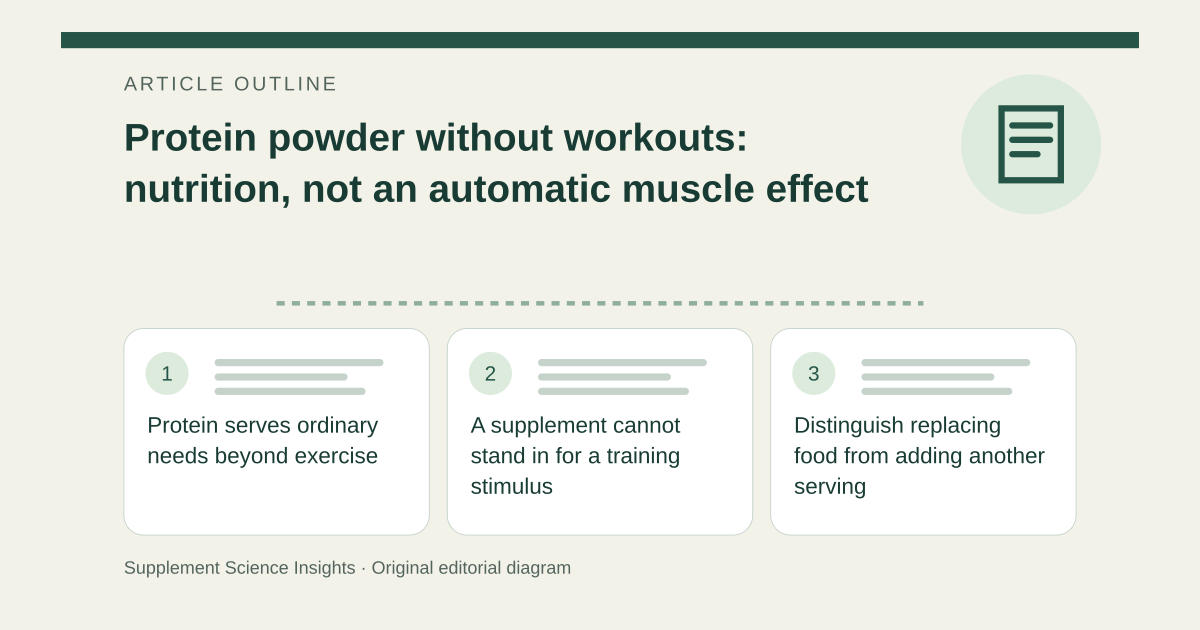
Protein serves ordinary needs beyond exercise
Dietary protein supports repair and replacement of cells and is important for growth and development. Those functions continue in people who do not perform organized workouts. [1][2]
A protein powder supplies the nutrient whether it is used after exercise or at another time. The absence of a workout does not make it chemically unusable; the question is whether it fits the person’s nutritional intake. [1][2]
A supplement cannot stand in for a training stimulus
ODS explains that resistance exercise and adequate protein contribute to training adaptations. A study conducted during resistance training does not establish the same muscle gain from supplementation alone. [1][2]
If food already meets the relevant need, adding a shake is an addition to intake, not proof of an additional muscle-building effect. It can also add calories, which belong in the overall energy pattern. [1][2]
Distinguish replacing food from adding another serving
Imagine a person uses a shake instead of a snack that provided the same protein. That differs from keeping the snack and adding the shake on top.
The first change substitutes one source for another; the second increases intake. Neither description alone predicts a specific amount of muscle or fat gained.
| Detail | Meaning |
|---|---|
| Replaces a comparable snack | A substitution |
| Added to the same meals | Additional intake |
| No resistance training | Training-study gains cannot be assumed |
Use the reason for the supplement to guide the comparison
Convenience or difficulty meeting food needs can be practical reasons for considering a supplement. They are different from expecting powder to replace movement or resistance exercise. [1][2]
Someone following a medically prescribed diet should assess the added protein within that plan. Healthy-exercise findings do not define suitability for every medical condition. [1][2]
Sources for this article
- MedlinePlus: Protein in diet
Source consulted: 2026-09-17. This is a reference resource, not a claim that we conducted the studies or tested a product. - NIH ODS: Dietary Supplements for Exercise and Athletic Performance
Source consulted: 2026-09-17. This is a reference resource, not a claim that we conducted the studies or tested a product.