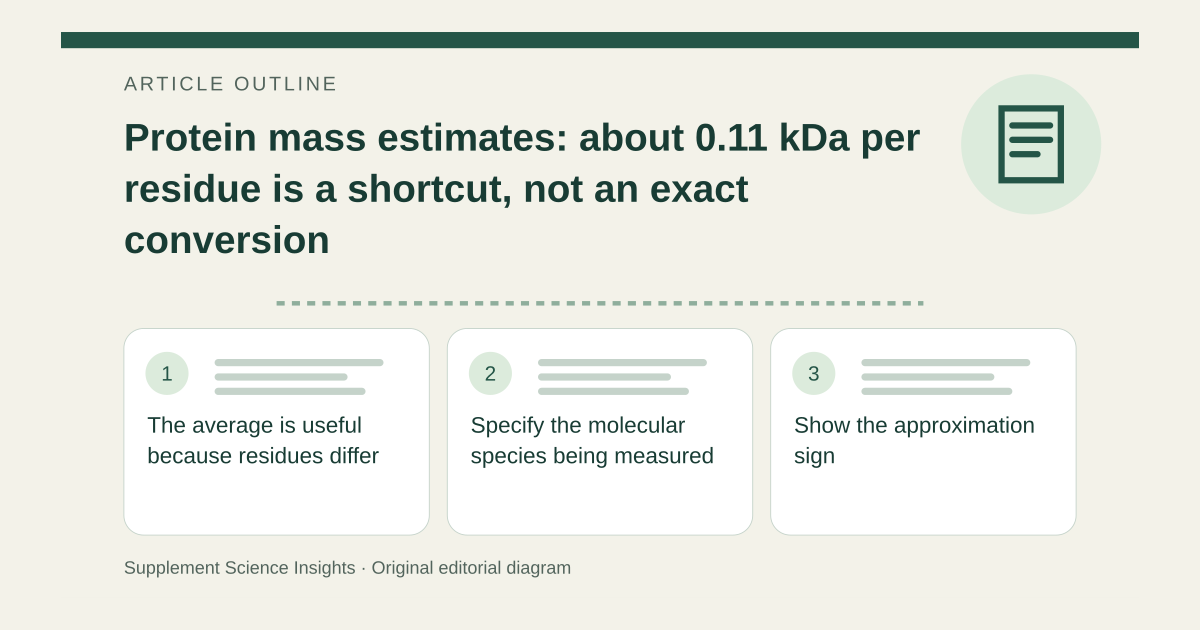
The average is useful because residues differ
The Bio-Rad teaching manual uses about 110 daltons per residue to estimate protein mass. Since a kilodalton is 1,000 daltons, this corresponds to approximately 0.11 kDa per residue. A 300-residue chain would therefore be estimated at about 33 kDa. [1][2]
This is an average across an assumed composition. Individual amino acids have different masses, so two chains of the same length need not have exactly the same molecular mass. The shortcut is most useful when only a rough size is needed. [1][2]
Specify the molecular species being measured
An exact calculation needs the actual sequence and the relevant chemical form. Modifications, cleavage and assembly into multiple-chain complexes can change what a reported mass refers to. A mass for one subunit is not automatically the mass of the complete complex. [1][2]
Do not use this molecular-size estimate to infer grams of dietary protein, serving size or absorption. Kilodaltons describe molecular mass, whereas grams on a nutrition label describe the amount of material in a serving. The units answer different questions. [1][2]
Show the approximation sign
Imagine a chain has 200 residues. Multiplying 200 by 0.11 gives an estimated 22 kDa. Reporting exactly 22.000 kDa would imply precision not supplied by the averaging method.
| Description | Interpretation |
|---|---|
| 200 residues × 0.11 kDa | Approximately 22 kDa |
| Actual sequence | Needed for greater precision |
| Grams per serving | A separate quantity |
Sources for this article
- Bio-Rad: Protein Profiler teaching manual
Source consulted: 2026-09-17. This is a reference resource, not a claim that we conducted the studies or tested a product. - OpenStax Organic Chemistry: Structures of Amino Acids
Source consulted: 2026-09-17. This is a reference resource, not a claim that we conducted the studies or tested a product.