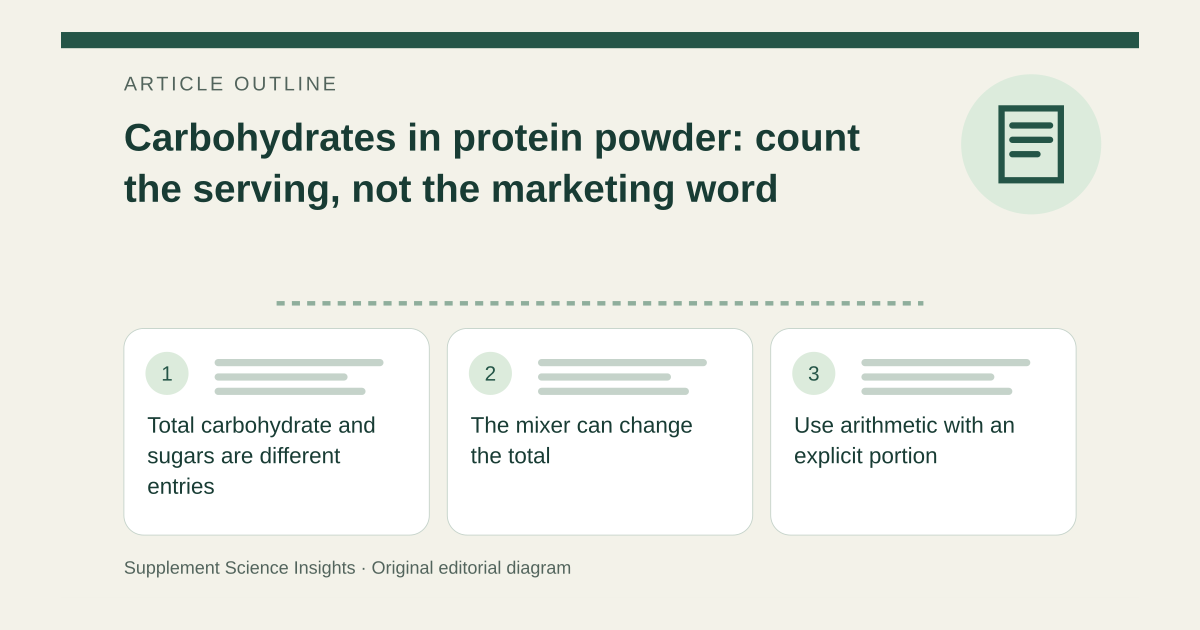
Total carbohydrate and sugars are different entries
FDA’s label guide distinguishes total carbohydrate, dietary fiber, total sugars and added sugars. A low or zero added-sugar number therefore does not establish zero total carbohydrate. Read the relevant entries together. [1]
All declared amounts apply to the specified serving. If a person uses twice that amount of powder, the nutrient contribution generally doubles; scoop volume should not be confused with the label’s gram weight. [1]
The mixer can change the total
Milk, fruit and other additions can contribute carbohydrates and calories beyond the powder’s declaration. Assess the finished drink rather than only the front of the tub. [1]
Whether that intake fits a dietary or medical plan is an individual question. A marketing category is not a universal carbohydrate allowance, and the label does not establish a treatment effect from restricting carbohydrates. [1]
Use arithmetic with an explicit portion
Imagine a powder provides 4 g total carbohydrate per serving and someone uses one and a half servings. The powder contributes 6 g before any mixer is added. A no-added-sugar claim would not change that calculation.
| Detail | Interpretation |
|---|---|
| Added sugars | One component |
| Total carbohydrate | Broader amount |
| One and a half servings | Multiply by 1.5 |
Sources for this article
- How to Understand and Use the Nutrition Facts Label | FDA
Source consulted: 2026-09-17. This is a reference resource, not a claim that we conducted the studies or tested a product.