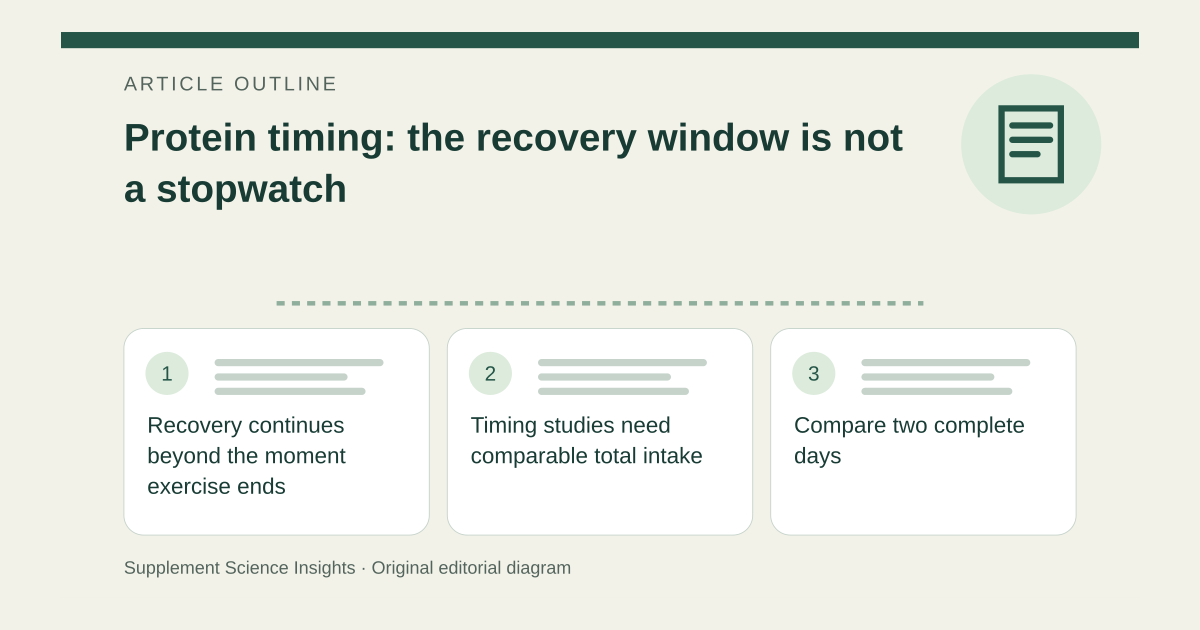
Recovery continues beyond the moment exercise ends
Exercise changes muscle protein breakdown and synthesis. ODS describes an extended recovery period, rather than a single minute after which dietary protein becomes useless. [1]
Its summary discusses early post-exercise intake but also reports that a meta-analysis did not find a significant strength or size advantage simply from consuming protein within an hour before or after exercise. These findings do not support a rigid universal deadline. [1]
Timing studies need comparable total intake
If one group receives more protein over the day than another, an observed difference cannot cleanly identify timing as the reason. Food consumed before training also belongs in the overall pattern. [1]
ODS discusses distributing high-quality protein across the day. That is a planning approach, not proof that a particular shake minute is essential or that a food meal is inferior to powder. [1]
Compare two complete days
Imagine one athlete eats a protein-containing meal after training and another uses a shake immediately afterward. Comparing the clock times alone ignores what each ate before training and across the rest of the day.
To investigate a timing advantage, preserve total protein, training and the measured outcome as well as the intake time. Convenience can still favor one option without proving it physiologically superior.
| Detail | Meaning |
|---|---|
| Time after exercise | One relevant detail |
| Total daily protein differs | Quantity may explain a difference |
| Long-term strength is the goal | Look for that measured outcome |
Short-term synthesis is not the final training outcome
A short-term increase in muscle protein synthesis does not by itself establish a larger long-term change in strength or muscle mass. ODS describes different kinds of endpoints within this literature. [1]
This page summarizes that government discussion and does not independently reappraise every timing trial or prescribe a meal schedule for a medical condition. [1]
Sources for this article
- NIH ODS: Dietary Supplements for Exercise and Athletic Performance
Source consulted: 2026-09-17. This is a reference resource, not a claim that we conducted the studies or tested a product.