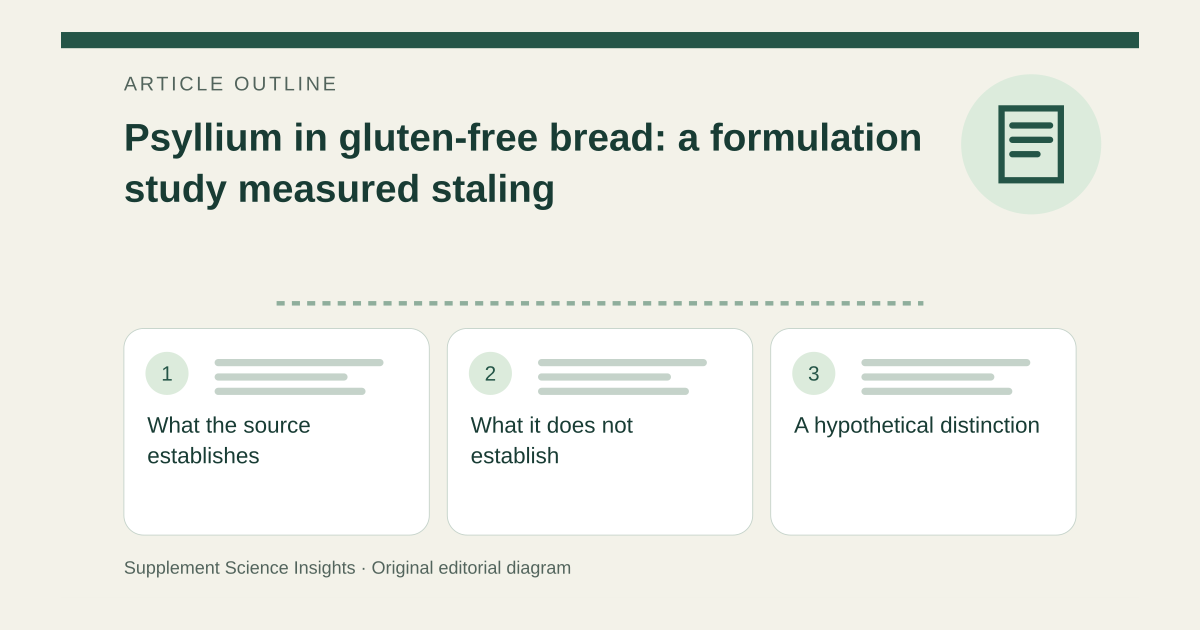
What the source establishes
Researchers compared gluten-free breads containing several psyllium proportions with a gluten-free control and wheat breads. They assessed texture and acceptability over 72 hours after production. [1]
Psyllium-containing breads had lower crumb firmness than the gluten-free control. The highest tested proportion produced the longest delay in staling, and sensory ratings were broadly similar to the wheat comparators. [1]
What it does not establish
This was a food-formulation study, not a clinical trial or a universal replacement ratio for flour or eggs. Water adjustment matters when transferring a recipe. The authors declared no conflicts; sponsor names were not established from the abstract. [1]
A hypothetical distinction
Imagine adding the same dry ingredient to two recipes with different water contents. The resulting textures need not match the experimental bread.
| Detail | Interpretation |
|---|---|
| Psyllium proportion | One formulation variable |
| Water level | Adjusted in the experiment |
| Clinical benefit | Not tested |
Sources for this article
- Psyllium Improves the Quality and Shelf Life of Gluten-Free Bread - PubMed
Source consulted: 2026-09-19. This is a reference resource, not a claim that we conducted the studies or tested a product.