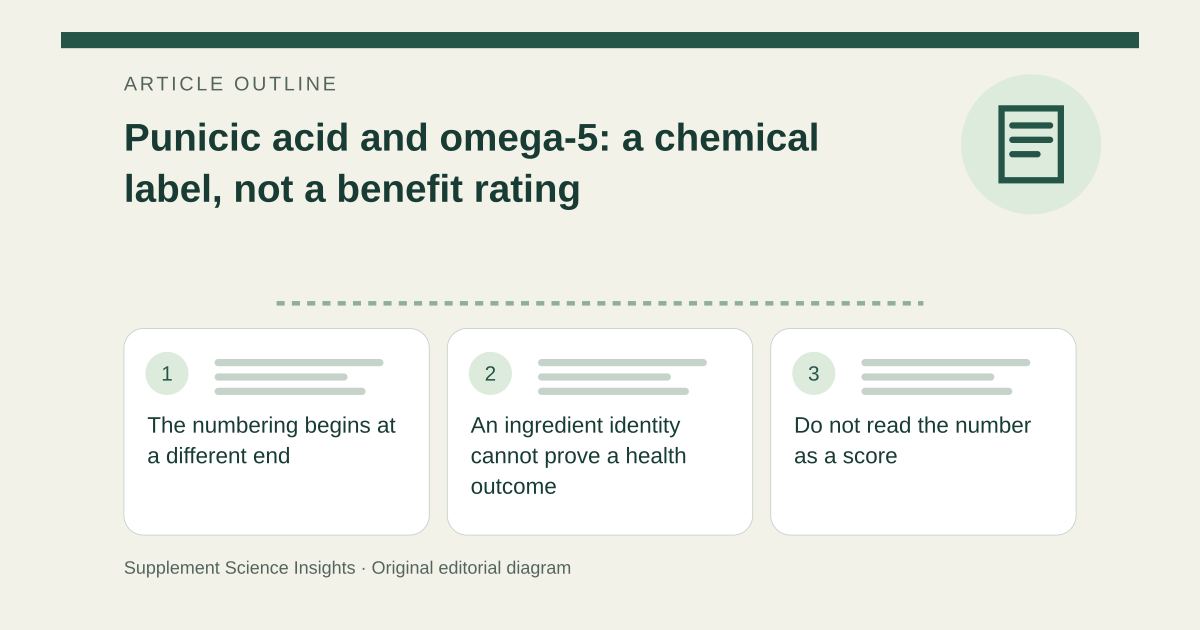
The numbering begins at a different end
ChEBI identifies punicic acid’s double bonds at positions 9, 11 and 13 when counted from the carboxyl end. For the 18-carbon chain, the nearest double bond is five carbons from the methyl end, giving the omega-5 designation. [1][2]
The curated entry reports its isolation from pomegranate. That occurrence information identifies a natural source; it does not establish an effective supplement dose. [1][2]
An ingredient identity cannot prove a health outcome
A chemical database describes what a compound is. It is not a clinical trial demonstrating improved metabolism, skin health or another advertised benefit. [1][2]
This page therefore makes no therapeutic claim for punicic-acid supplements. Evidence about a different omega family should not be transferred solely because both names contain omega. [1][2]
Do not read the number as a score
Imagine a product suggests omega-5 is stronger than omega-3 because five is larger. The numbers describe structural positions, not potency.
| Detail | Interpretation |
|---|---|
| 18-carbon chain | Structural length |
| Omega-5 | Double-bond position |
| Health benefit | Requires separate evidence |
Sources for this article
- (9Z,11E,13Z)-octadecatrienoic acid (CHEBI:8638)
Source consulted: 2026-09-18. This is a reference resource, not a claim that we conducted the studies or tested a product. - Omega-3 Fatty Acids - Health Professional Fact Sheet
Source consulted: 2026-09-18. This is a reference resource, not a claim that we conducted the studies or tested a product.