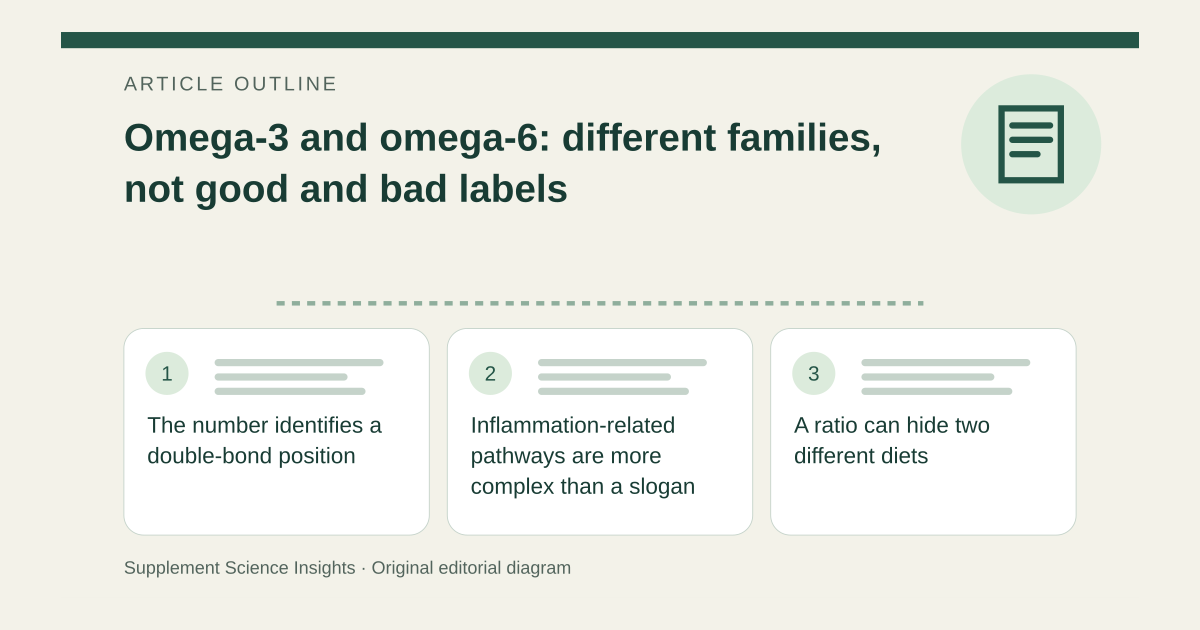
The number identifies a double-bond position
Omega-3 and omega-6 are families of polyunsaturated fatty acids. The names identify where a double bond lies when counted from the methyl end of the molecule: the third carbon for omega-3 and the sixth for omega-6. [1]
ALA is an essential omega-3, while linoleic acid is an essential omega-6. Essential means a dietary supply is required. Treating all omega-6 intake as something the body should eliminate ignores that nutritional role. [1]
Inflammation-related pathways are more complex than a slogan
Both families contribute to cell structures and signaling molecules. ODS explains that some omega-6-derived signals have stronger inflammatory effects than corresponding omega-3-derived signals, but there are exceptions. [1]
This biochemical comparison does not establish that eating any omega-6-containing food causes disease or that adding any omega-3 supplement treats inflammation. Dose, dietary context and actual clinical outcomes remain separate evidence questions. [1]
A ratio can hide two different diets
Imagine one diet supplies two units of one fat for every unit of another, and a second supplies twenty for every ten. Both have a two-to-one ratio, although their absolute amounts differ tenfold.
A ratio alone cannot identify the amount of either fatty acid or establish which dietary change would be useful.
| Detail | Interpretation |
|---|---|
| 2 compared with 1 | Ratio 2:1 |
| 20 compared with 10 | Also 2:1 |
| Absolute intake | Still differs tenfold |
An optimal universal ratio has not been established
ODS states that an optimal omega-6-to-omega-3 ratio, if one exists, has not been defined. It also describes criticism that the ratio is too nonspecific to capture individual fatty-acid levels. [1]
This page therefore does not prescribe a ratio target or an oil-elimination plan. It explains the terminology without converting a mechanism into a clinical promise. [1]
Sources for this article
- NIH ODS: Omega-3 Fatty Acids
Source consulted: 2026-09-17. This is a reference resource, not a claim that we conducted the studies or tested a product.